Getting Around Prague in 2026: Transport Guide for Travelers
Master the metro, trams, and streets of the city that rewards those who know how to move through it
Powered by ITINE
Get this guide as a tappable itinerary
Day-by-day plan, audio tours, and one-tap Google Maps — completely free.
Destinations
Your Itinerary
Google Maps
Prague is one of those rare European capitals where the public transport is so well-designed that it almost feels like cheating. Three metro lines, a web of trams that have been running since the 1870s, a unified ticketing system, and a historic center compact enough to cross on foot in under thirty minutes -- this city makes it easy to get anywhere, as long as you know the system. And a few of its traps.
The Metro: Fast, Clean, and Deep Underground
Prague's metro has three lines -- A (green), B (yellow), and C (red) -- that intersect at three central transfer stations: Muzeum (A/C), Můstek (A/B), and Florenc (B/C). The system runs from approximately 5:00 AM to midnight, with trains arriving every 2-3 minutes during peak hours and every 5-10 minutes at off-peak times. It is the fastest way to cover long distances across the city.
Line A is your workhorse for sightseeing: Malostranská drops you at the foot of Malá Strana and the Castle district, Staroměstská puts you near Old Town Square, and Náměstí Míru lands you in the heart of Vinohrady. Line C connects the main train station (Hlavní nádraží) and Florenc bus terminal. Line B is less tourist-centric but reaches Smíchov, Karlovo náměstí, and the eastern suburbs.
Trams: The Best Way to See the City
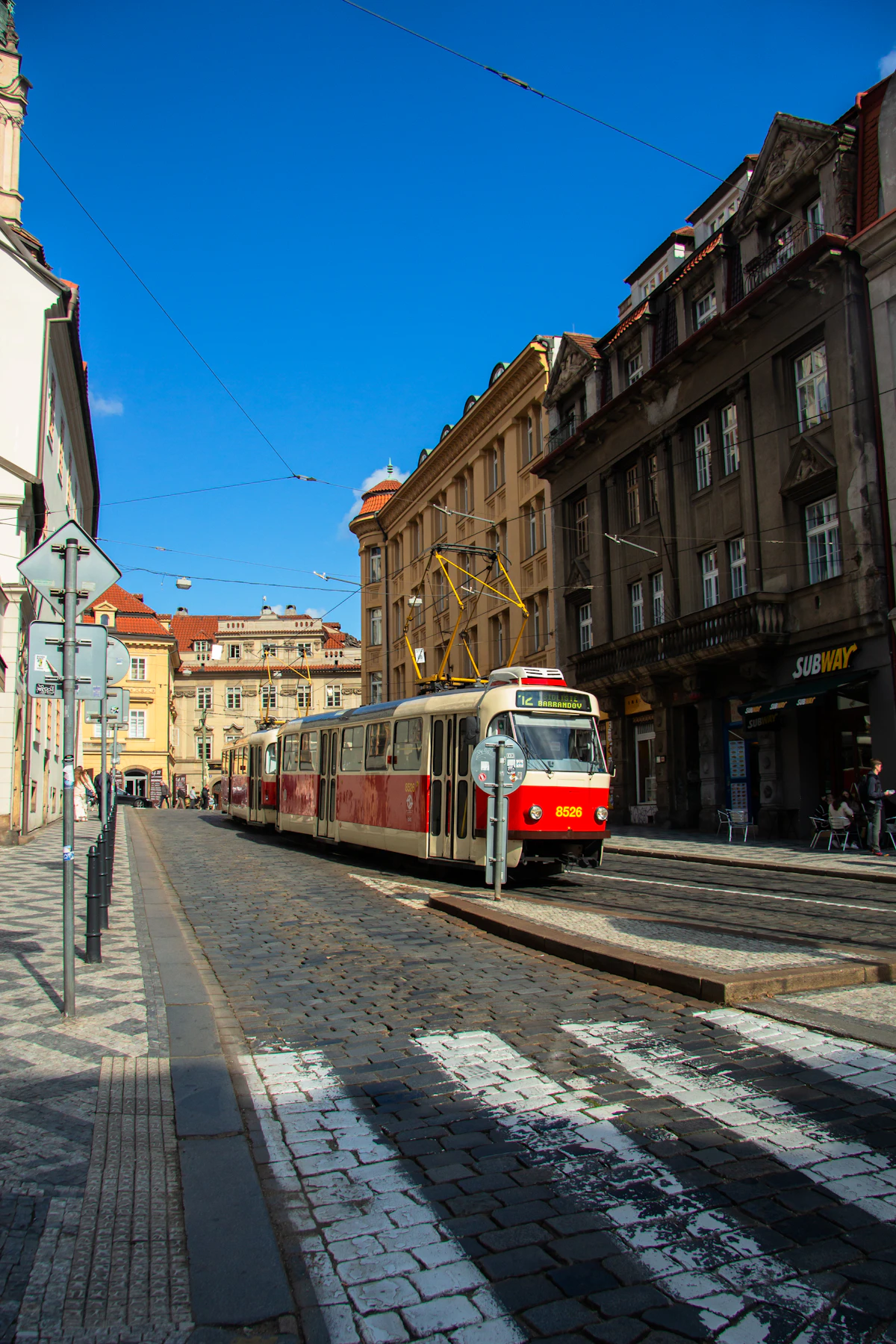
If the metro is Prague's backbone, the tram network is its nervous system. Over thirty daytime lines and nine night lines crisscross every neighborhood, and riding one is genuinely one of the best ways to experience the city. Tram 22 is legendary -- it climbs from Národní třída through Malá Strana, past Prague Castle, and onward to Strahov. Sit by the window and you get a free sightseeing tour.
Trams run from about 4:30 AM to midnight, after which the night tram network takes over. Night trams (numbered 91-99) run every 30 minutes and converge at Lazarská, near Národní třída. They are safe, reliable, and often the best option for getting home after a late night in Žižkov or Vinohrady.
- Tram 22 -- the classic sightseeing line from Národní třída to Prague Castle and beyond
- Tram 17 -- follows the Vltava riverfront, connecting Výtoň to Holešovice
- Tram 9 -- useful for reaching Žižkov and the eastern neighborhoods
- Tram 1 -- connects Sídliště Petřiny through Dejvice and Hradčanská to Spojovací
- Night tram 97 -- the key late-night line through the center
Buses: For the Edges and Beyond
Buses fill in where the metro and trams do not reach -- outer neighborhoods, hillside areas, and suburbs. You will rarely need them in the city center, but they are essential for reaching places like the Prague Zoo (bus 112 from Nádraží Holešovice), Divoká Šárka nature reserve, or the Barrandov studios area. The same tickets and passes work across all three systems.
Bus 119 deserves special mention as the airport connector, but beyond that, bus 143 is handy for reaching the Troja château (note: the château may be temporarily closed — check before visiting) and botanical garden, and bus 176 climbs to the Barrandovské terasy viewpoint -- one of Prague's least-visited panoramic spots. Buses also serve as the backbone of the night transport system alongside night trams, with routes numbered 901-915 covering the outer zones after midnight.
Night Transport: The After-Midnight Network
Prague does not shut down at midnight -- it shifts gears. When the metro closes at approximately 12:00 AM, a comprehensive night network of trams and buses takes over and runs until the metro reopens around 5:00 AM. Night trams are numbered 91 through 99 and operate every 30 minutes throughout the night. The critical hub for all night trams is the Lazarská stop, located near Národní třída in the New Town. Nearly every night tram route passes through Lazarská, making it the single most important interchange point after dark.
The system is designed so that night trams arrive at Lazarská within a few minutes of each other, allowing timed transfers. If you miss a connection, the next batch arrives in 30 minutes -- annoying but predictable. Night buses (numbered 901-915) fill in suburban routes and connect to the outer metro stations. The same tickets and passes work on night services with no surcharge.
Safety on night transport is generally not a concern. The trams are well-lit, often have other passengers even at late hours, and Prague is statistically one of the safest capitals in Europe. The biggest risk is falling asleep and riding past your stop -- it happens more often than anyone admits, especially on the longer suburban routes after a few too many Pilsners.
Tickets: The PID System and Lítačka App
Prague's integrated transport system is called PID (Pražská integrovaná doprava), and a single ticket works on the metro, trams, buses, and even the Petřín funicular. You have several options depending on how long and how much you plan to ride.
- 30-minute ticket -- 30 CZK (about 1.20 EUR). Good for short hops on trams or a quick metro ride.
- 90-minute ticket -- 40 CZK (about 1.60 EUR). The standard choice. Allows unlimited transfers within the time window.
- 24-hour pass -- 120 CZK (about 4.80 EUR). Best value if you plan to make four or more trips in a day.
- 72-hour pass -- 330 CZK (about 13.20 EUR). Ideal for a long weekend visit.
The easiest way to buy tickets is through the Lítačka app (available on iOS and Android). You purchase and validate your ticket digitally -- no need to find a yellow machine or hunt for coins. The app also works as a journey planner and shows real-time departures. Download it before you arrive. For tips on maximizing passes and saving on transport costs, see our Prague budget guide.
Common Ticketing Mistakes Tourists Make
The PID system is straightforward once you understand it, but several mistakes trip up first-time visitors repeatedly. The most common is assuming that a validated ticket lasts for the entire day -- it does not. A 30-minute ticket means exactly 30 minutes from the moment of validation, and a 90-minute ticket gives you 90 minutes of unlimited transfers. Once the time expires, you need a new ticket for your next journey, unless you have purchased a day pass.
- Forgetting to validate -- buying a ticket is not enough. Paper tickets must be stamped in the yellow machines on trams and buses or at metro station entrances before you pass the platform level.
- Using an expired SMS ticket -- if you bought a ticket via SMS before switching to Lítačka, note that SMS tickets are no longer sold as of recent system updates. Use the app instead.
- Not having a ticket for luggage -- technically, any bag larger than 25x45x70 cm requires its own half-price ticket (15 CZK). Inspectors rarely enforce this for normal suitcases, but oversized items can attract attention.
- Assuming children ride free at any age -- children under 6 ride free. Ages 6-15 get half-price tickets. Teens 15+ pay full fare. Carry proof of age if your child looks older than they are.
- Trusting hotel-sold tickets -- some hotels sell transit tickets at markup. Always compare with the Lítačka app price.
Taxis and Rideshare: Navigating the Minefield
Prague's taxi reputation has improved over the past decade, but the old scams linger in tourist hotspots. Hailing a cab off the street near Old Town Square, Wenceslas Square, or Charles Bridge is still risky -- some drivers use rigged meters or take "scenic" routes that triple the fare. The solution is simple: never hail from the street in the center.
Use Bolt (the most popular rideshare app in Prague), Liftago (a Czech-made alternative), or order a taxi through the AAA Taxi or Tick Tack apps. All of these show the fare estimate upfront and route the driver via GPS, eliminating the detour scam entirely. Bolt is generally the cheapest option and has excellent coverage across the city.
- Bolt -- cheapest, most widely used, surge pricing during peak hours
- Liftago -- Czech app, reliable, slightly higher base fares than Bolt
- AAA Taxi -- the largest traditional taxi company, good reputation, app booking available
- Uber -- operational in Prague but less popular than Bolt
Walking: The Center is Yours on Foot
Truthfully, walking is the best way to experience Prague's historic core. The distance from Old Town Square to Prague Castle via Charles Bridge is about 2 kilometers -- a 25-minute walk if you do not stop, though you will stop constantly. From Wenceslas Square to the Dancing House is a fifteen-minute stroll along the river. Vinohrady to Žižkov is a gentle ten-minute walk through residential streets. The city reveals its best details at pedestrian pace: the sgraffito facades, the gaslit passageways, the courtyards hidden behind heavy wooden doors.
A word about the cobblestones: they are beautiful and merciless. Wear sturdy, flat-soled shoes with good grip. Heels are a bad idea on most streets in Malá Strana and Old Town. When it rains, the polished stones become genuinely slippery, especially on the approach to Charles Bridge and the Castle stairways.
Day Trip Logistics: Trains from Hlavní nádraží
Prague's main train station, Praha Hlavní nádraží, is a gorgeous Art Nouveau building on metro line C. From here, Czech Railways (České dráhy) runs frequent trains to Kutná Hora (1 hour), Český Krumlov (2.5 hours via České Budějovice), Karlštejn Castle (40 minutes), and Karlovy Vary (3 hours). RegioJet and Leo Express offer private alternatives on major routes, often with better onboard service -- leather seats, free coffee, and WiFi.
Book through the České dráhy app (CD.cz) or RegioJet.cz for the best prices. RegioJet often has return tickets to Český Krumlov for as little as 200 CZK if booked in advance. For Karlštejn, just buy at the station -- trains leave every hour and it is a short, scenic ride through the Berounka valley.
Airport Transfer: Václav Havel to the Center
Václav Havel Airport (PRG) sits about 17 kilometers west of the city center. Our dedicated Prague airport guide covers every detail, but here is the summary. You have several options for getting in, and the right choice depends on your budget, luggage situation, and arrival time.
- Airport Express bus (AE) -- runs every 30 minutes to Hlavní nádraží, costs 100 CZK, takes about 35-45 minutes. The most efficient public option.
- Bus 119 + Metro A -- bus 119 runs from the airport to Nádraží Veleslavín (metro A terminus), about 17 minutes. From there, the metro takes you into the center in another 10-15 minutes. Total cost: one standard 40 CZK ticket.
- Bolt/Liftago -- typically 400-550 CZK to Old Town, 25-40 minutes depending on traffic. The most comfortable option for two or more travelers splitting the fare.
- Prague Airport Transfers (pre-booked shuttle) -- around 600 CZK for a private car, booked online in advance. Driver waits with a name sign in arrivals. Reliable for late-night landings.
Bike and Scooter Sharing
Prague has embraced bike and e-scooter sharing in recent years. Nextbike (rebranded as Rekola in the Czech version) offers pink bikes docked at stations throughout the city, while Lime and Bolt e-scooters are scattered across most neighborhoods. The riverfront paths along the Vltava, the Stromovka park loop, and the route from Vyšehrad to Podolí are particularly pleasant cycling routes.
A few caveats: the cobblestone streets of Old Town and Malá Strana are brutal on bikes and scooters. Hills around the Castle district will drain e-scooter batteries fast. And Czech law requires cyclists to have a blood alcohol level of 0.0% -- unlike the more lenient rules for pedestrians. Save the bike rides for the parks and river paths, not the pub crawl.
- Rekola (Nextbike) -- pink station-based bikes, 30 CZK for 15 minutes, docking stations across the city
- Lime -- e-scooters, 25 CZK unlock fee + 4 CZK per minute, available in most central neighborhoods
- Bolt e-scooters -- same pricing structure as Lime, integrated into the Bolt app you may already have for rides
- Prague Bike rental shops -- for full-day rentals (from 400 CZK/day), several shops near Old Town Square and Náměstí Republiky offer quality bikes with locks, maps, and helmet included
River Ferries: Prague from the Water
One of Prague's most underused transport options is the public ferry system on the Vltava. The Prague Steamboat Company operates several routes, but more useful for everyday travel are the PID-integrated ferry lines -- small boats that cross the river at points where no bridge is nearby. These ferries are part of the public transport network, meaning your standard PID ticket or pass works on them at no extra cost.
The most useful ferry for visitors is the P5 line connecting Výtoň (near the Dancing House) to Smíchovské nábřeží on the west bank. The crossing takes just a few minutes and offers a brief but memorable perspective of the city from the water. The P1 ferry runs from Sedlec to Zámky in the northern suburbs -- less touristy but a lovely ride through the green edges of the city. Ferries operate from April through October, roughly 6:00 AM to 8:00 PM, with departures every 15-20 minutes.
Accessibility on Public Transport
Prague's accessibility record is mixed but improving steadily. The metro presents the biggest challenge: most stations on lines A and B were built in the 1970s-80s and have escalators but no elevators. However, all stations on the newer sections of Line A (from Dejvická westward to Nemocnice Motol) are fully barrier-free, as are many stations on Line C. The DPP website and Lítačka app mark which stations have elevator access, and this information is reliable.
Trams are more encouraging. Prague has been phasing in low-floor trams across the network, and the majority of services now use the modern Škoda 15T ForCity models with flat boarding, wide doors, and designated wheelchair spaces. Stops are announced audibly and shown on electronic displays inside each car. Bus routes similarly use low-floor vehicles on most lines, with a wheelchair symbol displayed on the timetable for accessible services.
- Wheelchair-accessible metro stations are marked with a wheelchair icon on all DPP maps and in the Lítačka app
- All new Škoda 15T trams have low-floor boarding, audio announcements, and priority seating
- Ramps at tram stops are standard on newer stops but inconsistent at older ones, especially in residential areas
- Bolt and Liftago both offer options to request wheelchair-accessible vehicles, though availability varies
- Prague Castle has a barrier-free route accessible from Hradčanská metro station via elevator and a gentle-grade path
Apps for Navigating Prague
Beyond the essential Lítačka, several apps make navigating Prague significantly easier. Google Maps works well for walking directions and has reasonable public transport data, but it is not always accurate on tram arrival times. For real-time departures, Lítačka and the DPP Info app are more reliable since they pull directly from the transit authority's live feed.
- Lítačka -- the essential app. Buy tickets, plan journeys, check real-time departures, and store your travel pass. Works offline for pre-purchased tickets.
- Mapy.cz -- the Czech alternative to Google Maps, developed by Seznam.cz. Superior for walking and hiking routes, with detailed trail markings and elevation data. Many locals prefer it over Google Maps for its accuracy in the Czech Republic.
- Bolt -- for rideshare bookings. Also includes e-scooter rentals in the same app.
- IDOS -- the national journey planner for trains and long-distance buses. Covers all Czech Railways, RegioJet, FlixBus, and regional connections. Essential for day-trip planning.
- Google Maps -- useful as a backup and for restaurant/attraction reviews, but cross-reference transit times with Lítačka for accuracy.
The Petřín Funicular and Other Oddities
The Petřín funicular is a charming leftover from the 19th century that climbs from Újezd in Malá Strana to the top of Petřín Hill, where the observation tower and rose gardens await. It runs every 10-15 minutes, takes about four minutes to reach the top, and accepts standard PID tickets. There is one intermediate stop at Nebozízek, which happens to be a restaurant with one of the best terrace views in Prague -- worth a stop even if you just order coffee.
Prague also has an extensive network of marked hiking and walking trails that begin right at the city's edge. The trail system uses the standard Czech marking system -- red, blue, green, and yellow blazes painted on trees and posts. From Divoká Šárka in the west to Prokopské údolí in the south, you can be on a forest trail within 30 minutes of leaving Old Town Square by tram. The Mapy.cz app is invaluable for finding these routes.
Quick Reference: Getting Around at a Glance
- Best app to download first: Lítačka (tickets + journey planner)
- Best rideshare app: Bolt (cheapest, widest coverage)
- Best tram for sightseeing: Tram 22
- Best metro line for tourists: Line A (green)
- Best way to the airport: Bus 119 + Metro A (budget) or Bolt (comfort)
- Best day trip train: RegioJet to Český Krumlov (book early for 200 CZK fares)
- Biggest trap: Street-hail taxis in Old Town and Wenceslas Square
- Best navigation app for Czech Republic: Mapy.cz (better than Google for local detail)
- Night transport hub: Lazarská (all night trams converge here)
- Contactless card payment: Tap Visa/Mastercard on validators -- fare capped at daily pass rate
- Funicular: Újezd to Petřín Hill, standard PID ticket, every 10-15 min
Prague rewards the traveler who slows down and pays attention. Ride the tram with nowhere specific to go and you will discover a neighborhood you never planned to visit. Walk the side streets instead of the main tourist arteries and you will find the city that locals actually inhabit. The transport system is not just infrastructure here -- it is part of the experience. Learn it, use it, and let it carry you to the corners of Prague that the tour buses never reach. For more practical advice on navigating the city like a local, see our 25 essential Prague travel tips.
Frequently Asked Questions
The Lítačka app is essential — it lets you buy tickets, plan journeys, check real-time departures, and store your travel pass. For walking and hiking routes, Mapy.cz (the Czech alternative to Google Maps) is superior. Use Bolt for rideshare bookings.
A 30-minute ticket costs 30 CZK (about 1.20 EUR), a 90-minute ticket is 40 CZK (about 1.60 EUR), a 24-hour pass is 120 CZK (about 4.80 EUR), and a 72-hour pass is 330 CZK (about 13.20 EUR). Children under 6 ride free, and ages 6-15 get half-price tickets.
Yes. Since 2024, you can tap any contactless Visa or Mastercard directly on the yellow validators on trams, buses, and at metro gates. The system automatically charges the best fare and caps at the daily pass rate. No app or ticket purchase needed — just tap and ride.
Plainclothes ticket inspectors patrol regularly and can issue on-the-spot fines of 1,500 CZK (reduced to 800 CZK if paid immediately). They carry official ID badges. Always validate your ticket before boarding or entering the metro. Digital tickets in Lítačka validate automatically at purchase.
The cheapest option is Bus 119 to Nádraží Veleslavín metro station then Line A into the center (40 CZK total, about 30 minutes). The Airport Express bus runs to Hlavní nádraží for 100 CZK. Bolt/Liftago rideshare costs 400-550 CZK. Never take taxis from unofficial drivers in the arrivals hall — they overcharge dramatically.
Street-hail taxis near Old Town Square, Wenceslas Square, and major hotels can still run scams with rigged meters or scenic detours. The solution is simple: never hail from the street in the center. Use Bolt (cheapest), Liftago, or the AAA Taxi app instead — all show fare estimates upfront.
When the metro closes around midnight, night trams (numbered 91-99) run every 30 minutes until about 5 AM. Nearly all converge at the Lazarská stop near Národní třída. Night buses (901-915) cover suburban routes. The same tickets and passes work with no surcharge.
Tram 22 is legendary — it climbs from Národní třída through Malá Strana, past Prague Castle, and onward to Strahov. Sit by the window and you get a free sightseeing tour. On weekends, the heritage tram line 42 runs a vintage 1920s-era car on a loop through the center.
Extremely. The distance from Old Town Square to Prague Castle via Charles Bridge is about 2 kilometers — a 25-minute walk. From Wenceslas Square to the Dancing House is 15 minutes along the river. The city reveals its best details at pedestrian pace. Just wear sturdy, flat-soled shoes — the cobblestones are beautiful but merciless.
Uber is operational in Prague but less popular than Bolt, which is the cheapest and most widely used rideshare app. Liftago is a Czech-made alternative with slightly higher base fares. All show fare estimates upfront and route via GPS, eliminating detour scams.
Prague's main train station (Hlavní nádraží, metro Line C) has frequent trains to Kutná Hora (1 hour), Český Krumlov (2.5 hours via České Budějovice), Karlštejn Castle (40 minutes), and Karlovy Vary (3 hours). Book through the České dráhy app or RegioJet.cz — RegioJet often has returns to Český Krumlov for as little as 200 CZK booked in advance.
Access is mixed. Most older stations on Lines A and B have escalators but no elevators. However, all newer sections of Line A (Dejvická westward) are fully barrier-free, as are many Line C stations. The Lítačka app marks accessible stations and can filter routes to use only accessible connections.
Yes. Rekola (Nextbike) offers pink station-based bikes at 30 CZK for 15 minutes. Lime and Bolt e-scooters are also available. However, cobblestone streets in Old Town and Malá Strana are brutal on bikes. Save cycling for the riverfront paths and parks. Czech law requires cyclists to have 0.0% blood alcohol level.
Yes, and they're an underused gem. PID-integrated ferry lines are part of the public transport network — your standard ticket or pass works at no extra cost. The P5 line connects Výtoň to Smíchovské nábřeží, and the P6 ferry to Císařský ostrov is almost entirely unknown to tourists. Ferries operate April through October.
The 72-hour pass at 330 CZK (about 13.20 EUR) is the best value for a long weekend — it covers unlimited metro, tram, bus, and even funicular rides. Alternatively, just tap your contactless bank card on every ride and the system caps at the daily pass rate automatically.
Yes. Prague has phased in low-floor trams across the network, and the majority of services now use modern Škoda 15T models with flat boarding, wide doors, and designated spaces. All trams in Prague are stroller-accessible. Not all older tram stops have raised platforms, but most central ones do.
James Whitfield
Travel Writer & Prague Resident · Vinohrady, Prague
James moved to Prague in 2017 after a decade of travel writing across Central Europe. A former editor at Wanderlust Magazine, he now writes practical travel guides drawn from eight years of navigating the city's tram network, budget pubs, and bureaucratic quirks.
You might also enjoy

Where to Stay in Prague in 2026: Best Neighborhoods and Hotels
Where should you stay in Prague? Compare 6 neighborhoods by price, vibe, and access to attractions. Updated for 2026 with hotel picks for every budget.
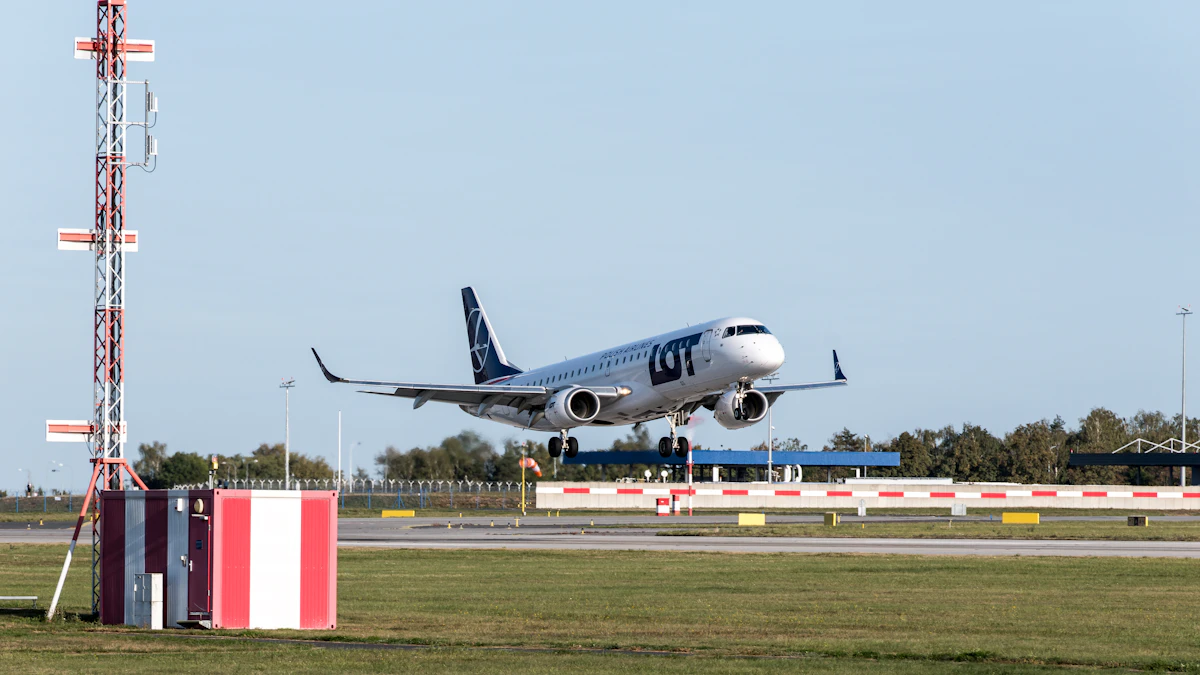
Prague Airport Guide: Arrivals, Transport, and Tips
Navigate Prague Airport like a pro. Compare bus, taxi, and rideshare options to the city center, plus tips on SIM cards, currency exchange, and scam avoidance.
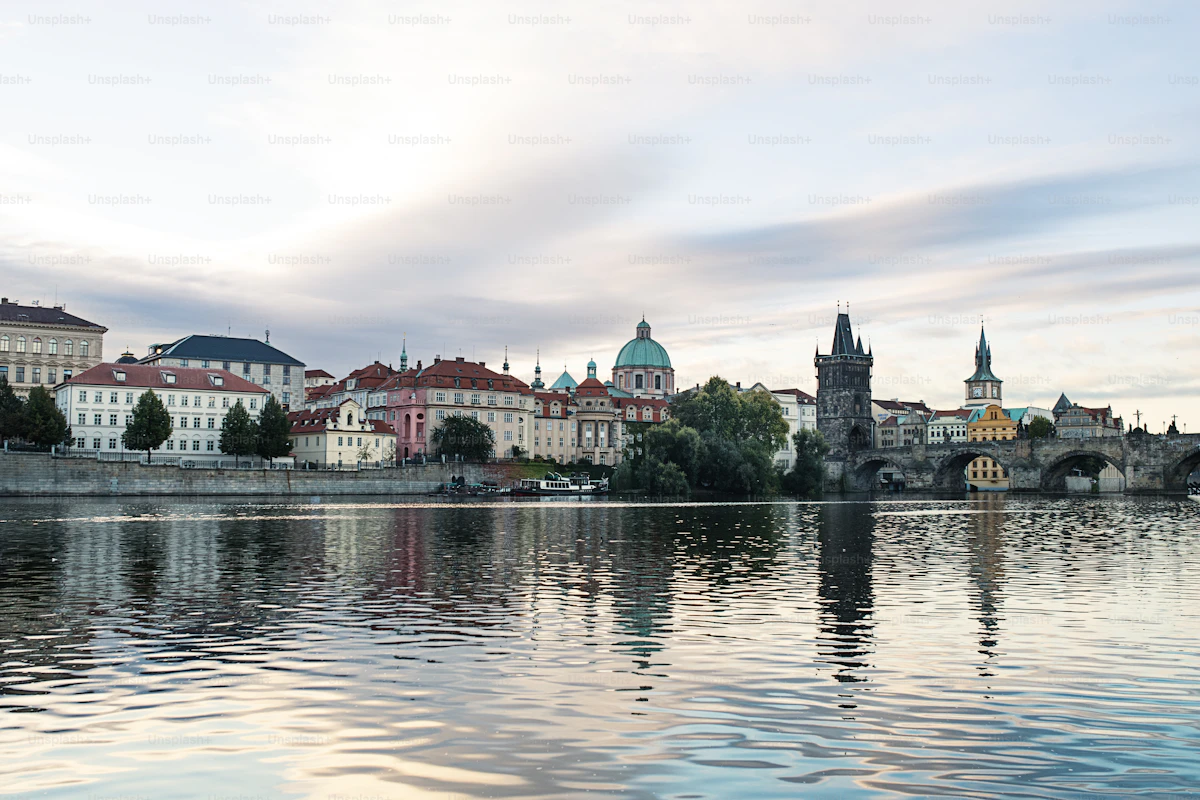
Prague on a Budget: Save Money Without Missing Out
Explore Prague on a budget with 50 CZK beers, free attractions, and lunch menus under 150 CZK. Get our complete money-saving tips for 2026.