Kutná Hora Day Trip: Bone Church and Beyond (2026)
Silver mines, a cathedral to rival any in Europe, and a chandelier made of every bone in the human body — all an hour from Prague
Powered by ITINE
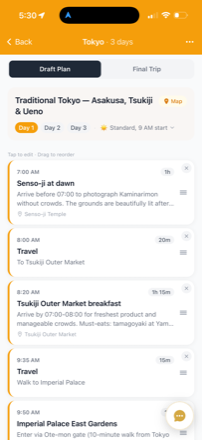
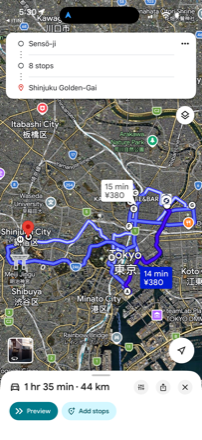
Get this guide as a tappable itinerary
Day-by-day plan, audio tours, and one-tap Google Maps — completely free.

Destinations
Your Itinerary
Google Maps
Why Kutná Hora
In the 14th century, Kutná Hora was the second-richest city in the Bohemian kingdom after Prague, and its silver mines funded the ambitions of Czech kings and Holy Roman Emperors alike. The royal mint here produced the Prague groschen — one of the most important currencies in medieval Europe. When the silver ran out, the city froze in time. What survives is a remarkably intact medieval town with two UNESCO World Heritage sites, a bone-decorated chapel that defies belief, and streets quiet enough to hear church bells from three directions at once.
Kutná Hora is the great counterweight to Prague — proof that Bohemian ambition was never confined to the capital. Walk its streets and you walk through the ghost of a medieval economic powerhouse.
— UNESCO World Heritage inscription commentary
The town earned its UNESCO World Heritage status in 1995, and the designation covers two distinct areas: the historical town centre with the Cathedral of St. Barbara and the Cathedral of Our Lady at Sedlec. Together these represent an outstanding example of medieval urban planning and architecture tied directly to the economic activity — silver mining — that created the town. Unlike many Czech towns that were heavily rebuilt in the Baroque era, Kutná Hora preserves its medieval skeleton. The street plan, the placement of churches in relation to mines, the hierarchy of civic and religious buildings — all of it is legible if you know what to look for. This is not a prettified museum town. It is a real place where people live and work, and that ordinariness is part of its power.
How to Get There
Take the train from Praha hlavní nádraží (Prague main station) to Kutná Hora hlavní nádraží. Our Prague transport guide covers the rail system and ticketing in detail. Direct trains run roughly every two hours and take about 55–65 minutes. The fare is around 120 CZK each way. Buy tickets at the counter, the yellow ticket machines, or through the České dráhy (ČD) app — the app occasionally offers discounted fares if you book in advance.
From Kutná Hora hlavní nádraží, a small local shuttle train runs one stop to Kutná Hora-Sedlec (3 minutes, included in your ticket). This drops you within walking distance of the Sedlec Ossuary. Starting at Sedlec and walking into the town centre is the most logical approach — you work from the outskirts inward, saving the cathedral and old town for last.
If you are driving, the journey from Prague takes about 75 minutes via the D11 motorway. There is a paid car park near the Sedlec Ossuary and another near the town centre. Driving gives you more flexibility with timing but removes the pleasant constraint of the train schedule, which for most visitors is a helpful framework for the day. Note that parking in the old town itself is limited, and several streets near the cathedral are pedestrianised.
The Sedlec Ossuary (Bone Church)
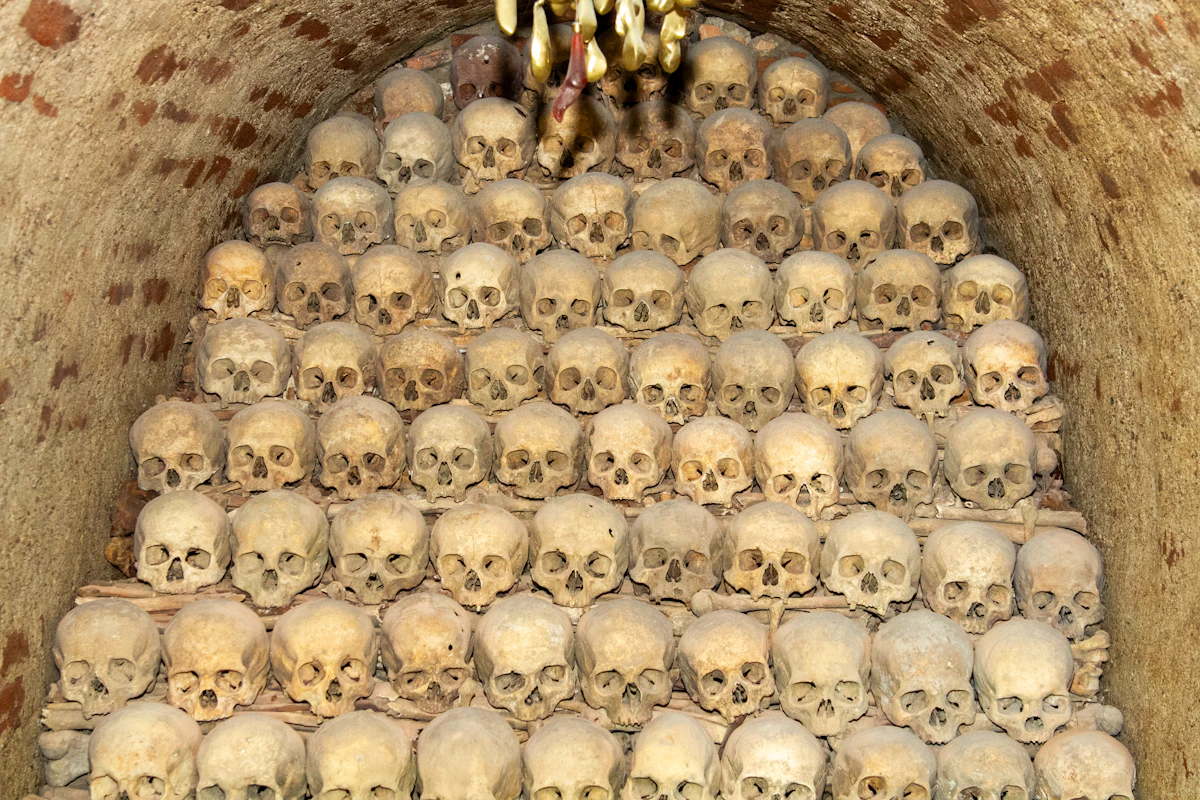
The Sedlec Ossuary (Kostnice v Sedlci) is what most people come for, and it delivers one of the most unforgettable experiences in Central Europe. This small Gothic chapel beneath the Cemetery Church of All Saints contains the artistically arranged bones of an estimated 40,000–70,000 people, most of whom died in the Black Plague of the 14th century and the Hussite Wars of the 15th.
In 1870, a local woodcarver named František Rint was hired to organize the heaps of bones that had accumulated in the ossuary over centuries. What he created is extraordinary and unsettling in equal measure: garlands of skulls drape from the vaulted ceiling, a massive chandelier containing at least one of every bone in the human body hangs in the centre of the nave, four enormous bell-shaped mounds of bones occupy the corners, and the Schwarzenberg coat of arms — rendered entirely in human bones, including a raven pecking out the eye of a Turkish skull — adorns the wall. Rint signed his work in bones near the entrance.
The history behind the bones begins in 1278, when the abbot of the Sedlec monastery returned from a pilgrimage to the Holy Land and scattered a handful of earth from Golgotha over the cemetery. Word spread that burial in this sanctified ground guaranteed salvation, and people from across Central Europe requested interment here. After the plague and the wars, the sheer volume of bones required a solution. The ossuary was the answer — practical, spiritual, and ultimately, artistic.
Sedlec Ossuary
Chapel & OssuaryZámecká 127, 284 03 Kutná Hora-Sedlec
Insider tip: Buy the combined ticket that includes the Ossuary, the Cathedral of Our Lady at Sedlec upstairs, and ideally the all-in-one pass covering St. Barbara and the Italian Court as well (300 CZK). It saves significant money versus individual tickets.
Cathedral of Our Lady at Sedlec
Just steps from the Ossuary, the Cathedral of Our Lady at Sedlec (Katedrála Nanebevzetí Panny Marie) is a masterpiece of Baroque Gothic restoration that most visitors overlook in their rush to the bones. Originally built as a Cistercian monastery church in the early 14th century, it was rebuilt by the great Baroque architect Jan Blažej Santini-Aichel in the early 18th century. Santini's style — sometimes called 'Baroque Gothic' — fused medieval structural forms with Baroque theatricality. The interior is luminous, airy, and profoundly strange: pointed arches meet sweeping curves, and the light pours in from unexpected angles. It was inscribed on the UNESCO World Heritage list alongside the Sedlec Ossuary.
The cathedral underwent a major restoration completed in 2014 that revealed the full brilliance of Santini's design. The clean white walls and restored stucco work now glow in the light that filters through clear glass windows — a deliberate contrast to the coloured glass of Gothic tradition. Give yourself at least 15 minutes here. The building rewards stillness. Sit in a pew, let your eyes adjust, and watch how the light moves through the space. On a sunny morning, the interplay of shadow and illumination across the vaulted ceiling is as moving as anything in the Ossuary below.
Walking to the Old Town
From Sedlec, the walk into Kutná Hora's old town centre takes about 25–30 minutes along a paved road. The route is straightforward and mostly flat. Alternatively, a local bus runs between Sedlec and the centre (check schedules at the bus stop near the Ossuary). The walk is pleasant if the weather cooperates — the road passes through quiet residential streets and gives you a sense of the town's scale.
What You'll Pass Along the Way
The walk from Sedlec to the old town is more interesting than it first appears. Shortly after leaving the Ossuary area, you will pass the former Sedlec Monastery grounds — once one of the wealthiest Cistercian houses in Bohemia. The Philip Morris tobacco factory, a major local employer housed in repurposed industrial buildings, sits along the route as a reminder that this is a living town with a working economy. As you approach the centre, the architecture shifts from 20th-century residential to older stone houses, and the spires of St. Barbara begin to emerge above the rooftops. The transitional zone between Sedlec and the old town gives you a sense of Kutná Hora's layered history — medieval, industrial, and modern all compressed into a small space.
The Cathedral of St. Barbara
The Cathedral of St. Barbara (Chrám sv. Barbory) is the crown jewel of Kutná Hora and one of the most remarkable Gothic churches in Europe. Dedicated to the patron saint of miners, it was begun in 1388, designed initially by Jan Parléř (son of the Peter Parler who built Charles Bridge and St. Vitus), and took over 500 years to complete. The exterior is a forest of flying buttresses, pinnacles, and a distinctive triple-tent roof. The interior is astonishing — late Gothic rib vaults that seem to float, frescoes depicting medieval mining life, and a luminosity that makes the space feel larger than its physical dimensions.
The approach to the cathedral is nearly as impressive as the building itself. A 17th-century terrace walk lined with Baroque statues of saints leads from the Jesuit College to the cathedral entrance, with views over the Vrchlice valley below. It is consciously designed to echo Charles Bridge — a processional path that builds anticipation for the architectural climax at the end.
Cathedral of St. Barbara
Gothic Cathedral (UNESCO)Barborská, 284 01 Kutná Hora
Insider tip: The best light inside the cathedral is in the late morning when the sun illuminates the south-facing windows. Walk the full perimeter of the exterior to appreciate the flying buttresses — the view from the terrace side, overlooking the valley, is the most dramatic.
The Italian Court
The Italian Court (Vlašský dvůr) was the royal mint of Bohemia from the late 13th century until 1726. Named after the Italian minting masters who were brought in to reform the coinage, this is where the Prague groschen — the dominant currency of medieval Central Europe — was produced. The guided tour (included in the combined ticket) takes you through the mint workshop, the chapel with original Gothic frescoes, and the royal audience hall where Wenceslas IV held court. The exhibition on medieval coin production is surprisingly engaging, and you can see replicas of the minting process in action.
The significance of the Prague groschen cannot be overstated. Introduced in 1300 by Wenceslas II, this silver coin became the standard currency across much of Central Europe for over two centuries. Its consistent weight and silver content made it the trusted medium of trade from the Baltic to the Adriatic. The Italian experts — brought from Florence — introduced techniques that guaranteed the coin's quality, and the mint operated under strict royal control. At its peak, the Italian Court employed hundreds of workers and produced millions of coins annually. The courtyard, with its Gothic arcades and the restored royal chambers above, gives you a vivid sense of the wealth and administrative power concentrated in this one building.
Italian Court (Vlašský dvůr)
Historic Mint & Royal PalaceHavlíčkovo náměstí 552, 284 01 Kutná Hora
Insider tip: The guided tour runs about 45 minutes. English tours are available at set times — ask at the ticket desk. The mint workshop demonstration where you can strike your own commemorative coin (for a small extra fee) is worth doing, especially with children.
The Silver Mines Tour
For a genuinely unique experience, descend into the medieval silver mines beneath the town. The Czech Museum of Silver (České muzeum stříbra), housed in the medieval fortress known as Hrádek, offers two tour routes. The shorter tour covers the museum exhibitions on mining history. The longer tour (Route II, roughly 90 minutes) takes you underground into actual medieval mine shafts — you don white overalls, a hard hat, and a headlamp, and squeeze through narrow tunnels that have not changed since the 14th century.
Czech Museum of Silver — Hrádek
Museum & Mine TourBarborská 28, 284 01 Kutná Hora
Insider tip: Book the Route II underground tour in advance if possible. It is one of the most unusual and memorable experiences you can have on a day trip from Prague. Allow 90 minutes for Route II.
Where to Eat
Kutná Hora's restaurant scene is modest but perfectly adequate for a day trip. The town is small enough that you will find lunch naturally during your walk between sites.
Restaurace Dačický
Traditional Czech RestaurantRakova 8, 284 01 Kutná Hora
Insider tip: Named after a local Renaissance chronicler, this is the best traditional Czech restaurant in town. The svíčková is excellent, the beer is well-kept, and the outdoor terrace in summer looks across the valley. Book if visiting on a weekend.
If you start your day at the Sedlec end of town, you may want a coffee before tackling the walk into the centre. There are a couple of simple options near the Ossuary, and once you reach the old town, several more choices for a full sit-down meal or a quick pub stop.
Kavárna Sedlec
Café & Light MealsNear the Sedlec Ossuary, Kutná Hora-Sedlec
Insider tip: A convenient stop for coffee and a pastry before or after the Ossuary visit. Nothing spectacular, but the coffee is decent and it saves you arriving in the old town hungry.
Pivnice Dačický
Pub & Czech CuisineJiřího z Poděbrad 9, 284 01 Kutná Hora
Insider tip: Related to but distinct from the Restaurace Dačický listed above — this is the pub-style sibling with a more casual atmosphere and slightly lower prices. The goulash with bread dumplings is hearty and well-priced. Good stop if the main restaurant is full.
V Ruthardce
Restaurant & Wine BarDačického náměstí 15, 284 01 Kutná Hora
Insider tip: The more refined dining option in town, set in a handsome Gothic cellar. The menu leans toward updated Czech classics with seasonal ingredients. The wine list features good Moravian selections. Reserve for weekend visits.
Combined Tickets
Photography Tips
Kutná Hora is exceptionally photogenic, but the best shots require some awareness of light and timing. In the Sedlec Ossuary, a wide-angle lens (or your phone's ultra-wide mode) is essential — the space is small and you will struggle to capture the chandelier and bone arrangements without it. Flash is not permitted, but the ambient lighting has been improved in recent years. Shoot at higher ISO settings (800-1600) and brace against a wall or pillar for stability. The most striking compositions frame the bone chandelier against the vaulted ceiling above.
The Cathedral of St. Barbara is best photographed from three vantage points: the terrace walk approach (use a telephoto or zoom for the compressed perspective of statues and spires), the garden below the southern wall (for flying buttresses against sky), and the Vrchlice valley viewpoint opposite the terrace. Inside, the rib vaults photograph best with a phone held vertically from the centre of the nave, looking straight up. The mining frescoes in the side chapels require patience — wait for other visitors to move through and shoot in available light, as flash washes out the delicate pigments.
Seasonal Considerations
Kutná Hora works as a day trip year-round, but each season changes the experience significantly. Spring (April–May) brings mild weather, blooming gardens around the cathedral terrace, and manageable crowds. This is arguably the ideal time to visit — warm enough for comfortable walking but before the summer tour-bus crush. The Ossuary and churches are open with full hours.
Summer (June–August) means the longest opening hours and the warmest weather for walking between sites, but also the heaviest crowds. The Ossuary can feel oppressively packed between 10:00 and 14:00 on summer weekends. The silver mine tours, by contrast, benefit from summer — the underground temperature of 10°C is a welcome escape from the heat above. If visiting in peak summer, start as early as the sites open and consider reversing the typical route to hit the Ossuary at day's end when groups have left.
Autumn (September–October) is excellent — the crowds thin dramatically after September, the light turns golden, and the deciduous trees along the Vrchlice valley below St. Barbara create a vivid backdrop. Some sites shift to shorter winter hours in late October, so check before you go. Winter (November–March) is the quietest time. You may have the Ossuary nearly to yourself on a weekday morning, and the cathedral interiors feel more contemplative with fewer visitors. The downside: shorter opening hours, the silver mine tours may be closed or reduced, and the 30-minute walk between Sedlec and the centre is less appealing in rain or sleet.
Combining with Other Stops
Kutná Hora is satisfying enough to fill a full day, but if you are planning an extended trip outside Prague, it can be combined with other stops. For another rewarding day trip in the opposite direction, see our Český Krumlov guide. The town of Kolín, a 20-minute train ride east of Kutná Hora, has a fine Gothic synagogue and a pleasant riverside setting — worth a brief stop if you catch an earlier train back and have an hour to spare. Čáslav, a small town further east on the same rail line, has a well-preserved town square and a connection to Jan Žižka, the one-eyed Hussite general.
For those with a car, the Sázava Monastery (about 30 kilometres southwest of Kutná Hora) is a lesser-known gem — a medieval monastery with Slavonic liturgical traditions that predates the more famous Sedlec monastery. The drive passes through rolling Bohemian countryside that feels centuries removed from Prague. However, combining car-based stops with a train trip to Kutná Hora is impractical. Choose one or the other: train for Kutná Hora alone, or car for a broader loop through Central Bohemia.
Suggested Day Plan
- 8:00 — Train from Praha hlavní nádraží
- 9:00 — Arrive Kutná Hora hl.n., shuttle to Sedlec
- 9:15 — Sedlec Ossuary and Cathedral of Our Lady
- 10:15 — Walk to old town centre (30 min)
- 10:45 — Italian Court guided tour
- 12:00 — Lunch at Restaurace Dačický
- 13:30 — Cathedral of St. Barbara and terrace walk
- 14:30 — Czech Museum of Silver or free exploration
- 16:00 — Wander the old town streets, coffee
- 17:00 — Walk back to station or take bus to Sedlec for return shuttle
- 18:00 — Train back to Prague (arrive ~19:00)
Kutná Hora is perfectly manageable in a single day from Prague. You will see the Ossuary, the two great churches, the mint, and have time for lunch without rushing. If you add the silver mine tour, plan for a slightly longer day — take a later return train. The town rewards a slow pace. Walk its quiet streets, look up at the medieval facades, and remember that this modest place once bankrolled an empire.
- Train: roughly 120 CZK each way, 55–65 minutes
- Combined ticket: ~300 CZK for all major sites
- Total day cost: approximately 800–1,200 CZK per person including transport, tickets, and lunch
- Bring comfortable walking shoes — the town is hilly with cobbled streets
- Download offline maps — mobile signal can be patchy in the mine tunnels and older parts of town
Practical Details and Final Notes
Kutná Hora's tourist information centre is located on Palackého náměstí (the main square) and is open daily during the season. The staff speak English and can help with maps, bus schedules, and event information. Public toilets are available at the Ossuary, the Italian Court, and near the cathedral — carry small change (10–15 CZK) as they are often coin-operated. There are ATMs on the main square and near the Italian Court, though most sites and restaurants accept credit cards.
- Accessibility: the Ossuary has steep stairs with no lift access. The cathedral and Italian Court are more manageable but not fully wheelchair-accessible. The silver mines are physically demanding and not accessible.
- Languages: signs and exhibits at major sites are in Czech, English, and German. Audio guides are available at St. Barbara and the Italian Court.
- Luggage storage: there is no left-luggage facility at Kutná Hora station. If coming with bags, consider using the lockers at Praha hlavní nádraží before departure.
- Wi-Fi: available at most restaurants and cafés in the centre. The tourist office also has free Wi-Fi.
- Emergency: the nearest hospital is in Kutná Hora. The European emergency number 112 works throughout the Czech Republic.
If you are building a multi-day plan around Prague, our 3-day Prague itinerary shows how to fit day trips into a longer visit. Of all the day trips possible from Prague, Kutná Hora strikes the best balance between accessibility and reward. It is close enough to feel effortless, rich enough to feel like genuine travel, and strange enough — a chandelier of bones, a cathedral funded by silver miners, a medieval mint that shaped European commerce — to stay in your memory long after the train deposits you back at Praha hlavní nádraží. Most visitors come for the bones. They leave remembering everything else.
Frequently Asked Questions
Take a direct train from Praha hlavní nádraží (Prague main station) — the journey takes 55-65 minutes and costs about 120 CZK each way. From Kutná Hora hlavní nádraží, a shuttle train runs one stop to Kutná Hora-Sedlec (3 minutes, included in your ticket), dropping you near the Bone Church.
Yes. The Sedlec Ossuary contains the artistically arranged bones of an estimated 40,000-70,000 people, including a chandelier made from every bone in the human body. It is one of the most unforgettable experiences in Central Europe. The visit takes only 20-30 minutes.
The best value is the combined ticket (around 300 CZK) covering the Sedlec Ossuary, Cathedral of Our Lady at Sedlec, Cathedral of St. Barbara, and the Italian Court. Individual tickets add up to significantly more. Student discounts are available with valid ID.
Absolutely. Take the 8:00 or 9:00 AM train from Prague, visit the Ossuary, walk to the old town, see St. Barbara's Cathedral and the Italian Court, have lunch, and catch a return train by 17:00-18:00. The total day cost is approximately 800-1,200 CZK per person.
A full day (6-8 hours) is ideal and allows you to see all the major sights — the Ossuary, Cathedral of Our Lady at Sedlec, the old town, St. Barbara's Cathedral, and the Italian Court — with time for lunch. If you add the silver mine tour, plan for a slightly longer day.
Visit early (before 10 AM) or during lunch hours (12:00-13:00) for the most space. Summer weekends between 10:00 and 14:00 are the most crowded. Winter weekday mornings are the quietest — you may have the Ossuary nearly to yourself.
Photography is allowed but selfies and posed photos among the bones are increasingly discouraged. Flash is not permitted. Use a wide-angle lens or your phone's ultra-wide mode — the space is small. Shoot at higher ISO settings (800-1600) and brace against a wall for stability.
The Cathedral of St. Barbara is one of the most remarkable Gothic churches in Europe. Dedicated to the patron saint of miners, it features extraordinary rib vaults, medieval frescoes depicting silver mining life, and a distinctive triple-tent roof. It took over 500 years to complete.
Yes, if you are not claustrophobic. The Route II tour (90 minutes, 200 CZK) takes you into actual medieval mine shafts — you wear overalls, a hard hat, and a headlamp, and squeeze through narrow 14th-century tunnels. It is one of the most unique experiences on any Prague day trip. Book ahead, especially in summer.
Restaurace Dačický is the best traditional Czech restaurant in town — excellent svíčková, good beer, and an outdoor terrace with valley views. Mains run 175-295 CZK. V Ruthardce offers more refined dining in a Gothic cellar. For coffee near the Ossuary, Kavárna Sedlec is a convenient stop.
RegioJet and FlixBus run bus services that are sometimes cheaper (from 59 CZK) but less frequent and slightly slower than the train. The bus drops you closer to the town center, which reverses the ideal walking route. For most visitors, the train is the better choice.
Start at Sedlec (Ossuary and Cathedral of Our Lady), then walk 25-30 minutes into the old town center. Visit the Italian Court, have lunch, then walk to St. Barbara's Cathedral via the Baroque terrace. This Sedlec-to-center route flows most naturally and saves the cathedral climax for last.
Spring (April-May) is ideal — mild weather, blooming gardens, manageable crowds. Autumn (September-October) offers golden light and thinning crowds. Summer has the longest hours but the heaviest crowds. Winter is the quietest — great for the Ossuary, but some sites have reduced hours.
Kutná Hora fills a full day on its own and should not be combined with Karlštejn (opposite direction from Prague). However, the town of Kolín is a 20-minute train ride east and makes a brief stop if you catch an earlier return train.
The Ossuary has steep stairs with no lift access and is not wheelchair accessible. The Cathedral and Italian Court are more manageable but not fully accessible. The silver mines are physically demanding. The 30-minute walk between Sedlec and the old town is paved and mostly flat.
For the main sights (Ossuary, St. Barbara, Italian Court), advance booking is not required — buy the combined ticket at any participating site. However, for the silver mine underground tour (Route II), booking ahead online or by phone is recommended, especially in summer.
Tereza Nováková
Food & Culture Journalist · Karlín, Prague
Tereza is a Prague-based food and culture journalist whose work has appeared in Czech Hospodářské noviny and The Forkful. She covers the Czech culinary scene from traditional hospoda kitchens to new-wave tasting menus, and organizes seasonal food walks through Prague's markets.
You might also enjoy
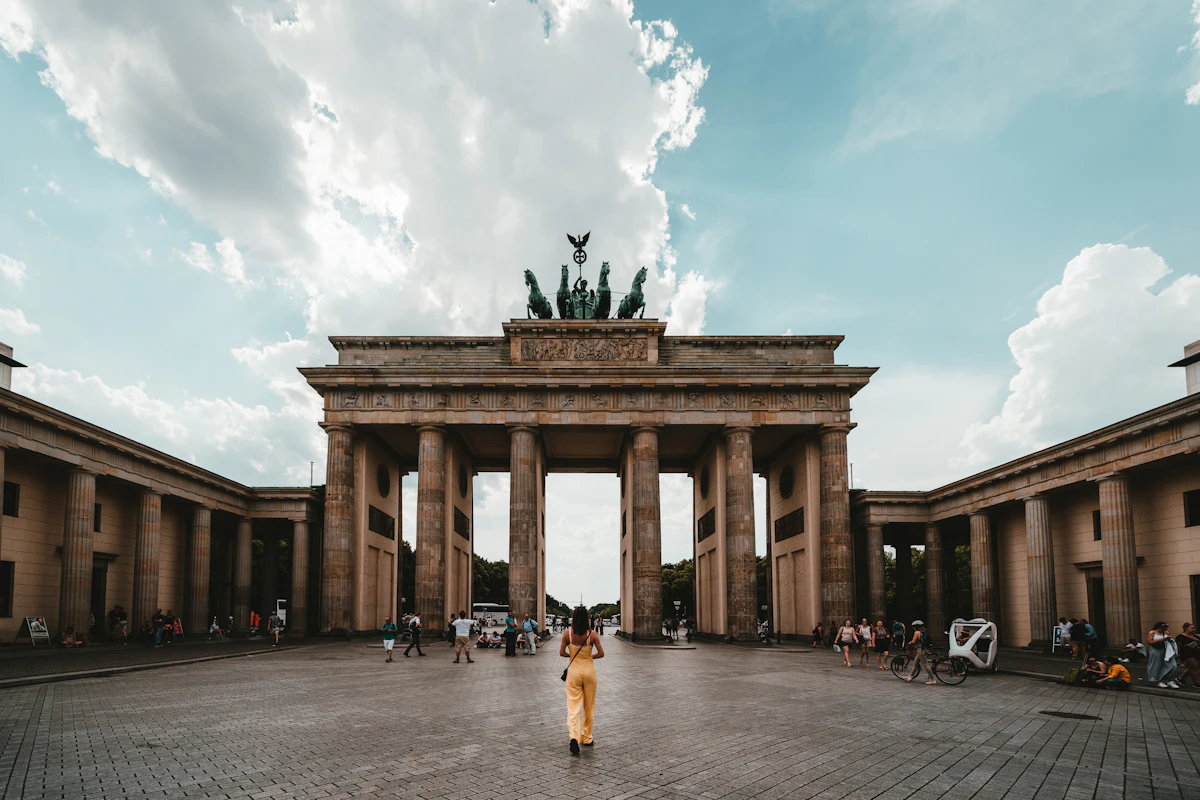
Český Krumlov Day Trip from Prague (2026)
Plan your 2026 Český Krumlov day trip from Prague with train times, a walking itinerary, river rafting tips, and the best lunch spots in this UNESCO town.
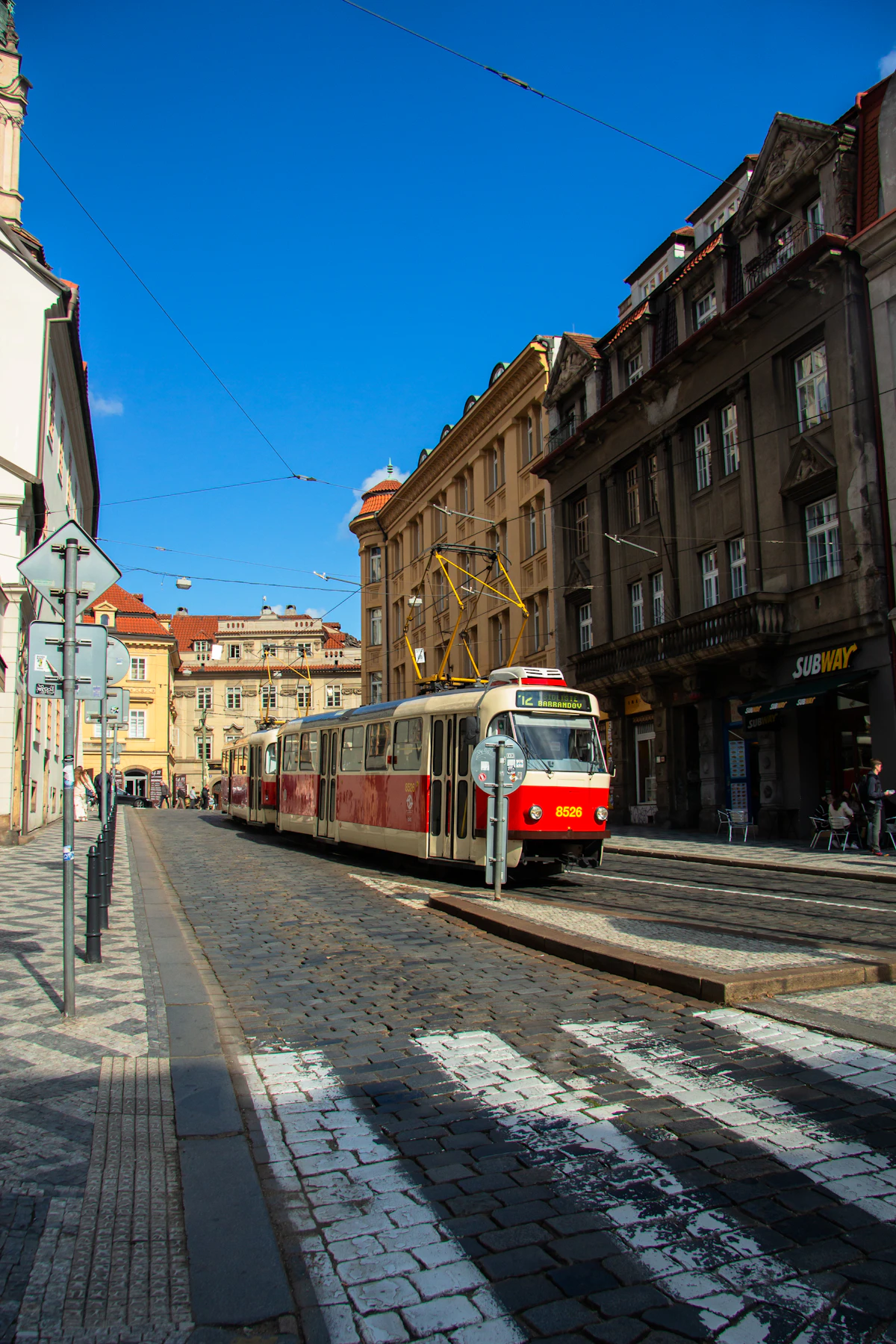
Getting Around Prague in 2026: Transport Guide for Travelers
How to use Prague's metro, trams, and buses as a tourist in 2026. Covers ticket prices, the Litacka app, taxi scam warnings, and getting to the airport.