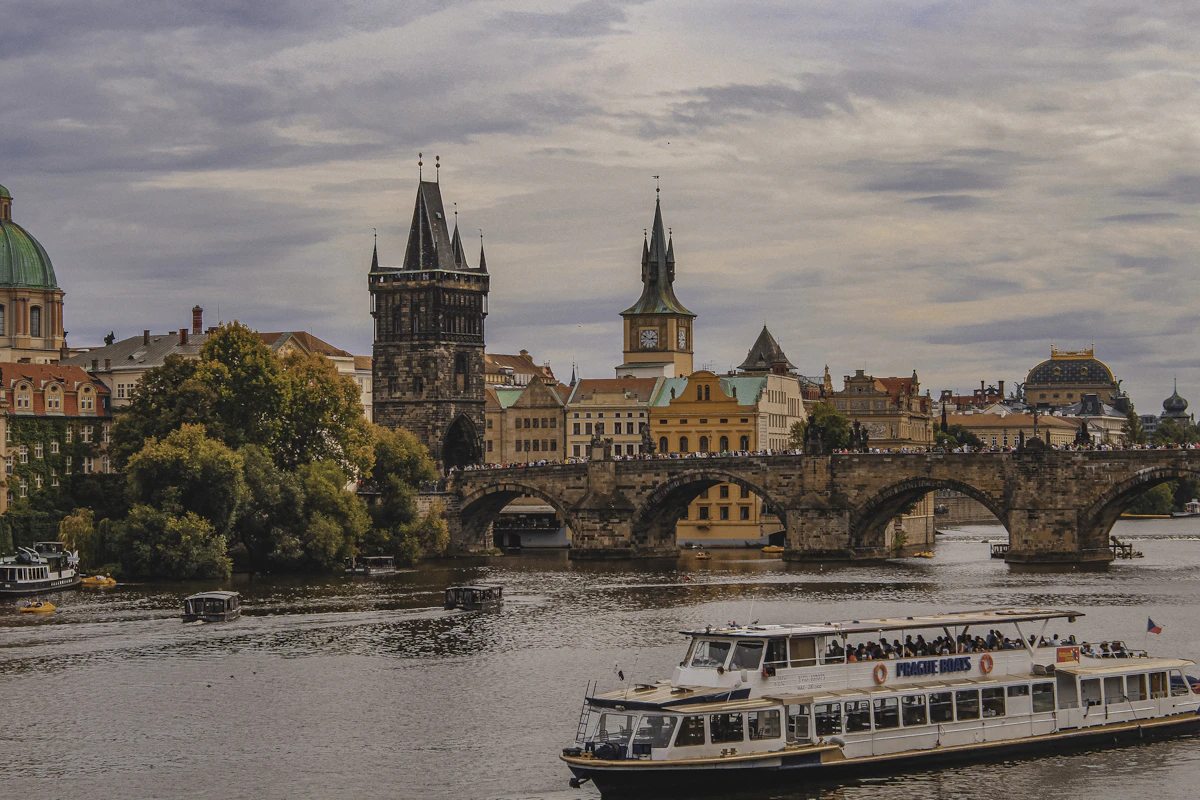
Prague Castle: The Complete Visitor's Guide (2026)
Everything you need to know about the world's largest ancient castle complex — from ticket circuits to secret gardens
Powered by ITINE
Get this guide as a tappable itinerary
Day-by-day plan, audio tours, and one-tap Google Maps — completely free.

Destinations

Your Itinerary
Google Maps
Prague Castle is not a monument to any single era. It is a monument to continuity — to the stubborn Czech insistence that power, art, and identity must all occupy the same space, however awkwardly they fit together.
— Prague Itinerary
Why Prague Castle Matters
Prague Castle (Pražský hrad) holds the Guinness record as the largest ancient castle complex in the world. Founded around 880 by Prince Bořivoj of the Přemyslid dynasty, it has served as the seat of Czech kings, Holy Roman Emperors, and every Czech president since 1918. The complex covers roughly 70,000 square metres — seven football pitches of palaces, churches, towers, and gardens layered over eleven centuries. It is not a building you visit; it is a small city you explore.
The Castle sits on a long ridge above Malá Strana and the Vltava, visible from almost every point in Prague. Its silhouette — dominated by the soaring Gothic spires of St. Vitus Cathedral — defines the city skyline. Understanding the Castle means understanding Prague itself: every architectural era, every political upheaval, every cultural movement left its mark somewhere within these walls.
A Brief History
The story begins in the late 9th century when Prince Bořivoj built a timber fortification on the Hradčany ridge. The first stone church — the Rotunda of the Virgin Mary — followed shortly after. By the 10th century the Castle was already the seat of Bohemian dukes and the administrative centre of the emerging Czech state. The Romanesque Basilica of St. George, still standing today, dates from 920.
Charles IV (1316–1378) transformed the Castle into an imperial residence worthy of a Holy Roman Emperor. He commissioned St. Vitus Cathedral in the French Gothic style, expanded the palace, and made Prague the largest city in Central Europe. The Hussite Wars, Habsburg rule, two defenestrations, Nazi occupation, and the Velvet Revolution all played out within these walls. When Václav Havel became president in 1989, he famously invited the Rolling Stones to play in the Castle courtyard — the ultimate symbol that a new era had begun. The complex is organized around three main courtyards running west to east: the first courtyard at Hradčanské náměstí, the second courtyard with ticket offices and the gallery, and the third courtyard containing St. Vitus Cathedral and the Old Royal Palace. Golden Lane and the eastern fortifications sit beyond the third courtyard. Thinking of the Castle as a linear sequence of courtyards — rather than a single building — will save you considerable confusion on arrival.
Ticket Options: Circuit A, B, and C
The Castle grounds are free to enter. You only need tickets for the interiors. Three ticket circuits are available, each covering a different combination of buildings. All tickets are valid for two consecutive days.
- Circuit A (350 CZK) — The full experience: St. Vitus Cathedral, Old Royal Palace, St. George's Basilica, Golden Lane with Daliborka Tower, the exhibition 'The Story of Prague Castle,' the Castle Picture Gallery, and the Powder Tower.
- Circuit B (250 CZK) — The essentials: St. Vitus Cathedral, Old Royal Palace, St. George's Basilica, and Golden Lane with Daliborka Tower. This is the best value for most visitors.
- Circuit C (200 CZK) — The abbreviated version: the exhibition 'The Story of Prague Castle' and the Castle Picture Gallery only. Skip this unless you have already seen the main buildings.
St. Vitus Cathedral
The Cathedral of St. Vitus, St. Wenceslas, and St. Adalbert is the spiritual heart of the Czech nation. Construction began in 1344 under the direction of French architect Matthias of Arras, continued under the Swabian genius Peter Parler, and was not completed until 1929 — nearly six centuries of construction that somehow produced a coherent masterpiece. The nave soars 33 metres, the main tower reaches 96.5 metres, and the interior is a symphony of Gothic vaulting, stained glass, and stone carving.
The highlights inside are extraordinary. The Mucha Window, in the third chapel on the left as you enter, is Alphonse Mucha's Art Nouveau interpretation of Saints Cyril and Methodius — a blaze of colour radically different from the medieval glass surrounding it. The Chapel of St. Wenceslas, decorated with semi-precious stones and 14th-century frescoes depicting the Passion of Christ, is the most sacred space in the building. The Royal Crypt below holds the sarcophagi of Charles IV, Wenceslas IV, Rudolf II, and other Bohemian kings. Note that the first third of the cathedral — the area immediately inside the western entrance — is free to enter, allowing you to admire the nave, the rose window, and the overall scale without buying a ticket. The Mucha Window, St. Wenceslas Chapel, Royal Crypt, and the tower climb all require Circuit A or B.
The Great South Tower
For visitors willing to climb 287 narrow, spiralling steps, the Great South Tower offers the single finest panoramic view in Prague. For more vantage points across the city, our hidden gems guide covers lesser-known panoramic spots. The ascent is relentless — there is no lift — but the reward at 96.5 metres is a 360-degree panorama that takes in the Vltava's bends, the terracotta sea of rooftops across Malá Strana and Staré Město, and on clear days the distant outline of the Bohemian hills. The tower also houses Zikmund, the largest bell in the Czech Republic, cast in 1549 and weighing 16.5 tonnes. You will pass it on the way up, and the sheer mass of the bell in its cramped chamber is strangely moving.
The Old Royal Palace
The Old Royal Palace is where the political drama happened. The Vladislav Hall, completed in 1502, is a vast late-Gothic chamber with a remarkable ribbed vault ceiling. It was large enough for indoor jousting tournaments — knights rode their horses up the purpose-built Riders' Staircase, which you can still see. Today the hall is used for presidential inaugurations and state ceremonies.
The room you should not miss is the Bohemian Chancellery, where the Second Defenestration of Prague took place on 23 May 1618. Two Catholic governors and their secretary were thrown from the window by Protestant nobles — they survived the 21-metre fall (Catholics credited divine intervention; Protestants pointed to the pile of manure below) — and the incident triggered the Thirty Years' War. The window is still there. Look out of it. Consider the fall.
Golden Lane
Zlatá ulička (Golden Lane) is a row of tiny, colourful houses built into the Castle fortification wall in the late 16th century. Originally home to Castle marksmen and goldsmiths (hence the name), the houses later sheltered the city's poor and, briefly, its most famous writer. Franz Kafka lived and wrote in house No. 22 during the winter of 1916–17, when his sister rented the blue cottage for him as a quiet retreat from their family's apartment.
Today the houses contain small exhibitions on medieval and Renaissance life in the Castle. The upper floor of the fortification wall houses a collection of armour and weapons. Golden Lane is charming but tiny — allow 20–30 minutes. It is included in Circuit A and B, but free to enter after 17:00 (April–October) or 16:00 (November–March) when the ticket gates are removed.
Daliborka Tower
At the eastern end of Golden Lane, Daliborka Tower served as a prison from the late 15th century. It is named after its first prisoner, the knight Dalibor of Kozojedy, who was imprisoned in 1498 for sheltering rebellious serfs. Legend says Dalibor taught himself to play the violin while awaiting execution, and his music could be heard floating over the Castle walls. Bedřich Smetana later used the story as the basis for his opera Dalibor. The tower interior displays instruments of torture and the underground cell where Dalibor was held.
Basilica of St. George
The Basilica of St. George is the oldest surviving church building in the Castle complex, founded in 920 and rebuilt in Romanesque style after a fire in 1142. Its terracotta Baroque facade, added in the 17th century, is misleading — step inside and you are in a Romanesque interior of austere, powerful simplicity. The twin stair towers and the crypt containing the tomb of St. Ludmila (grandmother of St. Wenceslas, murdered in 921) give the building a gravity that the Gothic extravagance of St. Vitus cannot match.
The Castle Picture Gallery
The Prague Castle Picture Gallery (Obrazárna Pražského hradu), housed in the Renaissance stables of the second courtyard, is one of Prague's most underappreciated art collections. Rudolf II, the eccentric Habsburg emperor who made Prague his capital from 1583 to 1611, assembled one of the greatest art collections in Europe — more than 3,000 paintings and sculptures. Much of it was looted by Swedish troops during the Thirty Years' War, but what remains is remarkable: works by Titian, Rubens, Tintoretto, Veronese, Hans von Aachen, and Bartholomeus Spranger hang in the vaulted rooms.
The gallery is included in Circuit A and Circuit C, but because most visitors focus on the cathedral and Golden Lane, the rooms are often nearly empty. You can spend 30 to 45 minutes studying works that would draw large crowds if they hung in a more prominent museum. The standout pieces include Titian's 'The Toilet of a Young Lady,' Rubens' 'The Assembly of the Olympic Gods,' and a collection of Mannerist paintings from Rudolf's court that give a vivid sense of the intellectual hothouse Prague was during his reign. If you only have Circuit B and want to add the gallery, a standalone ticket costs 100 CZK at the entrance in the second courtyard — one of the best-value art experiences in Prague.
The Powder Tower (Mihulka)
The cylindrical Powder Tower, tucked into the northern fortifications near the Cathedral, served as a gunpowder store, then as a workshop for bell founders, and eventually as a laboratory where Rudolf II's alchemists attempted to transmute base metals into gold. Today the interior houses a permanent exhibition on the Castle Guard and Renaissance-era craftsmanship, including arms, armour, and replicas of alchemical instruments. The tower is included in Circuit A and takes about 15 to 20 minutes to explore. Its rooftop offers a close-up view of the Cathedral's flying buttresses that you cannot get from ground level.
The Castle Gardens
The Castle's gardens are free and among the most overlooked treasures of the complex. The Royal Garden (Královská zahrada), north of the Castle across the Powder Bridge, was established by Ferdinand I in 1534 as a Renaissance pleasure garden. The Ball Game Hall (Míčovna), the Singing Fountain whose water drops produce a bell-like tone on the bronze basin, and the Belvedere summer palace — considered the purest Italian Renaissance building north of the Alps — are all here.
The South Gardens (Jižní zahrady) cascade down the hillside below the Castle's southern ramparts, offering spectacular views over Malá Strana and the red rooftops of the city. The terraced design connects the Castle to the lower town, and on warm evenings the gardens fill with locals who come for the sunset panorama. The gardens are open April through October.
The Stag Moat
The Jelení příkop (Stag Moat) is the deep natural ravine that separates the Castle's northern walls from the Royal Garden. Named for the deer that Rudolf II kept here for royal hunts, the moat is now a wooded gorge with walking paths that feel startlingly rural given their proximity to the Castle. The descent into the moat and the walk along its floor — beneath ancient stone walls draped in ivy — is one of the most atmospheric experiences in the entire complex. Very few tourists make it here, even in peak season.
The Changing of the Guard
The Castle Guard ceremony takes place every hour on the hour at the main gate in the first courtyard. A modest flag exchange happens each time, but the main event is at noon, when the full ceremonial changing of the guard takes place with a brass fanfare, flag ceremony, and formal inspection. The uniforms were designed by Theodor Pištěk, who won an Academy Award for his costume work on the film Amadeus. Arrive 10 minutes early for a good vantage point — the first courtyard fills quickly. For the best view, position yourself on the left side of the gate (as you face the Castle) near the stone balustrade. The fanfare musicians appear on the balcony above, so looking slightly upward gives you both the visual and musical experience. If you miss the noon ceremony, the smaller hourly changes are still worth a quick look.
Best Times to Visit
The Castle receives roughly 1.8 million visitors per year, and on summer days it can feel like most of them arrived at the same time you did. Timing is everything.
- Best time of day: Arrive at 9 AM when the interiors open. Head directly to St. Vitus Cathedral — most tour groups start at Golden Lane, so the cathedral is quieter in the first hour.
- Best day of the week: Tuesday through Thursday in shoulder season (April–May, September–October). Avoid weekends in summer at all costs.
- Best season: Late September and October — the crowds thin, the light turns golden, and the gardens are still open with autumn colour.
- Worst time: July and August midday, when queues for tickets can exceed 30 minutes and the interior spaces are packed.
How to Get There
The approach you choose changes the experience dramatically. There are three main routes, and one of them is definitively superior.
- Tram 22 to Pohořelec (recommended): Ride the scenic tram to the top of the Castle hill and enter from the western end. You walk downhill through the entire complex, emerging at the Old Castle Steps above Malostranská metro station. This is the least tiring and most logical route. Our Prague transport guide covers tram routes and ticket options in detail.
- Malostranská metro + Old Castle Steps: Take Line A to Malostranská and climb the stepped lane up to the eastern gate. Atmospheric but steep — allow 10 minutes of uphill walking.
- From Charles Bridge via Nerudova: Cross the bridge, walk through Malostranské náměstí, and climb the steep, cobbled Nerudova street directly to the Castle gate. The most scenic approach but also the most exhausting.
Photography Rules and Tips
Photography is permitted throughout the Castle complex, including inside St. Vitus Cathedral, with one important restriction: tripods and monopods are not allowed in interior spaces without a special permit. Flash photography is prohibited inside the Cathedral and the Basilica of St. George to protect the frescoes and stained glass. In practice, flash is unnecessary — the interiors are well lit by natural and ambient light, and modern camera sensors handle the conditions easily.
For the best exterior photographs, the view from the third courtyard looking up at the Cathedral's south facade is the iconic shot, but it requires a wide-angle lens to capture the full height from such close range. For the classic postcard view of the Castle itself — the full western facade with the Cathedral spires — cross the river to the eastern bank near the Mánes Bridge or shoot from the gardens at Letná Park. The golden hour before sunset paints the entire complex in warm tones, and the illuminated Castle after dark, seen from Charles Bridge, is one of the most photographed scenes in Europe.
Accessibility
The Castle complex presents significant accessibility challenges. The courtyards are paved with cobblestones, some uneven and steep. Wheelchair access is possible through the main (western) entrance from Hradčanské náměstí, and the first, second, and third courtyards are navigable on relatively flat cobbles. The ground floor of St. Vitus Cathedral is accessible, though manoeuvring inside can be difficult when crowds are heavy. A ramp provides entry to the Old Royal Palace's Vladislav Hall.
Golden Lane is narrow and uneven, with steps at several points, and the individual houses have raised thresholds that make wheelchair access impractical. The Great South Tower, Powder Tower, and Daliborka Tower are accessible only by stairs. The South Gardens involve steep terraced slopes. Visitors with mobility impairments should focus on the three courtyards, the Cathedral ground floor, and the Vladislav Hall — these alone provide a rich experience. Contact the Castle information centre in advance for assistance; staff can arrange alternative routes through service entrances where possible. For all visitors, the Castle's authentic cobblestones make sturdy, flat-soled footwear essential — heels and flip-flops are uncomfortable and potentially dangerous, and after rain the stones become genuinely slippery.
Combining the Castle with Nearby Sights
Prague Castle does not exist in isolation — the Hradčany district surrounding it contains several outstanding sights that can be woven into the same half-day visit. Immediately outside the main gate, Hradčanské náměstí is a grand square lined with aristocratic palaces, including the Schwarzenberg Palace (now housing the National Gallery's collection of Baroque art) and the Archbishop's Palace with its ornate Rococo facade. The Strahov Monastery, a ten-minute walk west along Pohořelec, contains one of the most beautiful historical libraries in Europe — the Theological and Philosophical Halls, their ceiling frescoes and floor-to-ceiling bookshelves unchanged since the 18th century.
Descending from the Castle, the Nerudova street offers a continuous gallery of Baroque house signs — look for the Two Suns (No. 47, where Jan Neruda lived), the Red Eagle, and the Three Fiddles. The street leads directly to Malostranské náměstí and the Church of St. Nicholas, Prague's finest Baroque interior. From there, Malá Strana's quiet back streets — Vlašská, Tržiště, Prokopská — wind through embassy gardens and small squares that feel untouched by tourism. A natural circuit is to start at the Castle, descend through Nerudova, explore Malá Strana, and finish at Charles Bridge — a half-day walk that covers the entire left bank of Prague's historic core.
Strahov Monastery Library
cultureStrahovské nádvoří 1, Prague 1
Insider tip: The library halls can only be viewed from the doorway — you cannot walk inside. The Strahov Gallery upstairs, housing Gothic and Baroque paintings, is less crowded and well worth the extra ticket.
Lobkowicz Palace
cultureJiřská 3, Prague Castle complex
Insider tip: The only privately owned building within the Castle complex. The audio guide, narrated by the Lobkowicz family themselves, is unusually personal and engaging. The palace holds original Beethoven and Mozart manuscripts, plus paintings by Canaletto, Bruegel, and Velázquez.
Practical Tips
- Allow 3–4 hours for a thorough visit with Circuit B, or 4–5 hours for Circuit A with gardens
- Wear comfortable shoes — the courtyards are cobbled and the complex involves significant walking
- The Castle's own restaurant options are overpriced and mediocre — eat in Malá Strana before or after your visit
- Free Wi-Fi is available in the second courtyard near the information centre
- The Castle is open daily: buildings 9:00–17:00 (April–October) or 9:00–16:00 (November–March); grounds open from 6:00
- The Prague Castle Picture Gallery, included in Circuit A, houses works by Titian, Rubens, and Tintoretto — it is underrated and usually uncrowded
- Toilets are available in the second courtyard and near Golden Lane — they cost a few crowns but are clean and well-maintained
- Audio guides are available in multiple languages for 350 CZK from the information centre in the second courtyard. They add useful context but slow your pace — allow an extra hour if using one
- The Castle grounds are open from 6 AM, well before the ticketed buildings open at 9 AM. An early morning walk through the empty courtyards, with the Cathedral lit by low sun, is a genuinely transcendent experience
A Suggested Itinerary for First-Time Visitors
If you have approximately four hours, the following route covers the essential sights in a logical sequence with minimal backtracking. For a full day-by-day plan that includes the Castle, see our 3-day Prague itinerary. Take tram 22 to Pohořelec and walk east through Hradčanské náměstí to the main Castle gate. Pass through security and the first courtyard. In the second courtyard, buy Circuit B tickets and note the location of the Castle Picture Gallery for later. Continue into the third courtyard and enter St. Vitus Cathedral immediately — it will be at its quietest in the first hour after opening.
After the Cathedral, cross the third courtyard to the Old Royal Palace. Spend time in the Vladislav Hall and the Bohemian Chancellery. Exit and walk to the Basilica of St. George, then continue east along Jiřská street to Golden Lane and Daliborka Tower. After Golden Lane, if time allows, descend into the South Gardens for the panoramic views. Exit the Castle via the Old Castle Steps, which deliver you to Malostranská metro station. The entire route moves east and downhill — following gravity rather than fighting it. With a full day, add the Castle Picture Gallery and Powder Tower in the morning (Circuit A), walk through the Stag Moat and Royal Garden after lunch, and visit the Lobkowicz Palace in the afternoon. End with an early evening walk down Nerudova to Malostranské náměstí for dinner.
Frequently Asked Questions
The castle grounds are free to enter. Interior tickets come in three circuits: Circuit A (350 CZK) is the full experience, Circuit B (250 CZK) covers the essentials (Cathedral, Palace, Basilica, Golden Lane), and Circuit C (200 CZK) covers only exhibitions. Students under 26 and seniors 65+ get roughly 50% off. Buy tickets online at hrad.cz.
Circuit B (250 CZK) is the best value for most visitors. It covers the four essential buildings: St. Vitus Cathedral, Old Royal Palace, Basilica of St. George, and Golden Lane. Circuit A adds the Picture Gallery and Powder Tower for 100 CZK more — worth it if you have 4+ hours and enjoy art.
The castle grounds open at 6:00 AM and close at 10:00 PM year-round. Interior buildings open at 9:00 AM and close at 5:00 PM (April–October) or 4:00 PM (November–March). Arrive at 9 AM to see St. Vitus Cathedral before the tour groups — most start at Golden Lane, so the cathedral is quieter in the first hour.
Take tram 22 to Pohořelec and enter from the western end. This is the smartest approach — you walk downhill through the entire complex instead of climbing the steep streets from Malá Strana. You emerge at the Old Castle Steps above Malostranská metro station.
Allow 3–4 hours for Circuit B, including the main buildings and a walk through the courtyards. Circuit A with gardens takes 4–5 hours. If you add the Lobkowicz Palace (separate 350 CZK ticket) and Stag Moat, budget a full day.
The first third of the cathedral — the area immediately inside the western entrance — is free to enter, allowing you to see the nave, rose window, and overall scale. However, the Mucha Window, St. Wenceslas Chapel, Royal Crypt, and deeper interior all require a Circuit A or B ticket.
Yes, but it requires a separate ticket (150 CZK) not included in any circuit. The climb is 287 narrow, spiralling steps with no lift and no rest platforms near the top. The reward is the single finest panoramic view in Prague. Not suitable for claustrophobia or mobility issues.
Golden Lane (Zlatá ulička) is a row of tiny colourful houses built into the castle walls in the 16th century. Kafka lived at No. 22 in 1916–17. It is included in Circuit A and B during the day, but free to enter after 5:00 PM (summer) or 4:00 PM (winter) when the ticket gates are removed.
A modest guard change happens every hour on the hour at the main gate. The full ceremonial version with brass fanfare, flag exchange, and inspection takes place at noon in the first courtyard. Arrive 10 minutes early for a good spot. The uniforms were designed by the Oscar-winning costume designer from Amadeus.
Partially. The three main courtyards are navigable on relatively flat cobbles, and the ground floor of St. Vitus Cathedral and the Vladislav Hall are accessible via ramps. Golden Lane, the towers, and the South Gardens are not wheelchair-accessible due to narrow passages and stairs. Contact the Castle information centre in advance for assistance.
Yes. The Royal Garden (north of the Castle) features the Renaissance Belvedere palace and the Singing Fountain. The South Gardens offer spectacular views over Malá Strana. Both are free and open April through October. The Stag Moat, a wooded ravine below the northern walls, is one of the most atmospheric and least visited areas of the entire complex.
The only privately owned building in the Castle complex. The 350 CZK ticket includes an audio guide narrated by the Lobkowicz family themselves. The palace holds original Beethoven and Mozart manuscripts, plus paintings by Canaletto and Velázquez. The balcony café offers one of the best lunch views in Prague.
Yes. Photography is permitted throughout the complex, including inside St. Vitus Cathedral. Tripods and monopods are not allowed indoors without a special permit. Flash photography is prohibited inside the Cathedral and Basilica to protect frescoes and stained glass.
Yes. All visitors pass through airport-style security screening at the Castle entrances. Queues can be significant at the main western gate during peak hours. The entrance from the Old Castle Steps (eastern side) typically has shorter lines. Large bags may cause delays.
The natural circuit is Castle, then Strahov Monastery (10-minute walk west, stunning library halls for 150 CZK), then descend through Malá Strana via Nerudova street to Charles Bridge. This covers the entire left bank of Prague's historic core in a half day.
Late September and October are ideal — crowds thin significantly, the light turns golden, and the gardens are still open with autumn colour. Avoid July and August midday when queues exceed 30 minutes and interiors are packed. Tuesday through Thursday in shoulder season is the sweet spot.
Klára Dvořáková
Prague Historian & Licensed Guide · Prague 1, Czech Republic
Born and raised in Prague's Staré Město, Klára holds a degree in Art History from Charles University and has been a licensed city guide since 2014. She specializes in Gothic and Baroque architecture, and leads walking tours through neighborhoods most tourists never find.
You might also enjoy
Malá Strana: Baroque Charm and Hidden Gardens (2026 Guide)
Explore Malá Strana, Prague's most romantic neighborhood in 2026. Discover hidden gardens, Baroque architecture, wine bars, Kampa Island, and where locals eat.
Best Time to Visit Prague in 2026: Month-by-Month Guide
When is the best time to visit Prague in 2026? Month-by-month weather, crowd levels, events, and packing tips to help you pick the perfect travel dates.