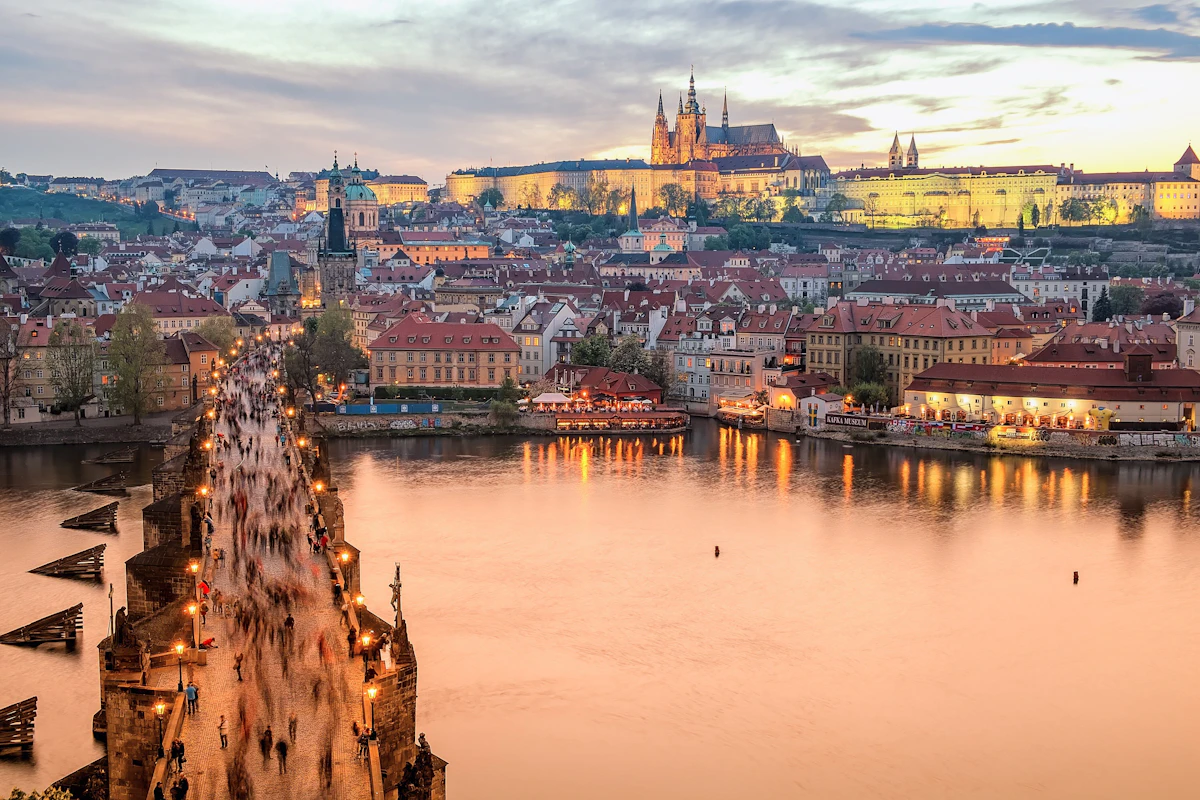
Vyšehrad: Prague's Ancient Fortress Guide (2026)
The mythic birthplace of Prague — a clifftop fortress with centuries of history, a national cemetery, and views most tourists never see
Powered by ITINE
Get this guide as a tappable itinerary
Day-by-day plan, audio tours, and one-tap Google Maps — completely free.

Destinations

Your Itinerary
Google Maps
The Mythic Origins of Prague
According to Czech legend, it was on the rocky cliff of Vyšehrad that Princess Libuše stood, gazed across the Vltava valley, and delivered her prophecy: 'I see a great city whose glory will touch the stars.' She sent her men to find a man building a threshold (práh) for his house, married him, and together they founded the Přemyslid dynasty and the city of Prague. The myth is almost certainly invented by later chroniclers, but standing on the Vyšehrad ramparts, watching the river curve below and the Castle shimmer on the opposite ridge, you understand why someone needed to believe the city began here.
The historical record is less romantic but still remarkable. Archaeological evidence places a fortified settlement on the Vyšehrad rock from at least the 10th century. In the 11th century, under Vratislav II, Vyšehrad briefly surpassed Prague Castle as the seat of Czech rulers. The fortress was expanded, a chapter church was established, and for several decades this clifftop commanded the political and spiritual life of Bohemia. When power shifted back to Prague Castle, Vyšehrad declined — but it never disappeared. Charles IV made it the starting point of every coronation procession, ensuring the mythic fortress remained woven into the identity of the nation.
The Slavín Cemetery
The Vyšehrad Cemetery (Vyšehradský hřbitov) is the national burial ground of the Czech Republic — the Père Lachaise of Prague, though far more intimate and manageable. Established in 1869 during the Czech National Revival, it was conceived as a final resting place for the nation's greatest cultural figures. Today approximately 600 graves fill the small, tree-shaded enclosure, and the names on the headstones read like a syllabus of Czech civilization.
- Antonín Dvořák (1841–1904) — composer of the New World Symphony, the Slavonic Dances, and Rusalka. His grave is marked by a white marble monument near the Slavín.
- Bedřich Smetana (1824–1884) — father of Czech music, composer of Má vlast (My Country) and The Bartered Bride. His grave features a lyre carved in stone.
- Alphonse Mucha (1860–1939) — the Art Nouveau master whose posters, stained glass (including the famous window in St. Vitus Cathedral), and Slav Epic defined Czech visual identity.
- Karel Čapek (1890–1938) — writer and playwright who coined the word 'robot' in his 1920 play R.U.R. His grave is modest compared to his influence.
- Emmy Destinn (1878–1930) — the opera soprano who sang at the Met and was celebrated across Europe as one of the great dramatic voices of her era.
- Jan Neruda (1834–1891) — poet and journalist whose Tales of Malá Strana captured the life of ordinary Praguers. Pablo Neruda later adopted his surname as a pen name.
The Slavín (meaning 'hall of fame') is a monumental shared tomb at the eastern end of the cemetery, designed by Antonín Wiehl and completed in 1893. It holds the remains of more than 50 notable Czechs beneath a sculptural group representing the Genius of the Nation. The Slavín is the centrepiece of the cemetery and the symbolic heart of Czech cultural identity — a place where artistic achievement is honoured with the same reverence other nations reserve for military heroes.
Basilica of Sts. Peter and Paul
The Basilica of Sts. Peter and Paul (Bazilika sv. Petra a Pavla) dominates the Vyšehrad skyline with its twin Neo-Gothic spires, added in the early 1900s. The church's history stretches back to the 11th century — Vratislav II founded the original Romanesque basilica — but the current building is the result of multiple reconstructions, the most significant being the Neo-Gothic renovation completed in 1903 by Josef Mocker.
The interior is the real surprise. Art Nouveau murals by František Urban and other Czech artists cover the walls and ceilings in elaborate decorative programmes depicting biblical scenes, Czech saints, and national iconography. The painted walls give the interior a warmth and richness that the austere exterior does not suggest. The Romanesque stone sarcophagus in the main nave — traditionally attributed to a member of the Přemyslid dynasty — connects the modern church to its ancient origins. Entry is 50 CZK.
The Casemates
Beneath the Vyšehrad ramparts lies a network of underground corridors and chambers known as the casemates (kasematy). Built in the Baroque era as part of the fortress's military defences, these vaulted brick passageways stretch for hundreds of metres beneath the rock. A portion is open to visitors as part of a guided tour (60 CZK, roughly 30 minutes).
The highlight of the casemate tour is Gorlice Hall — a large underground chamber that now houses six of the original Baroque statues from Charles Bridge. These stone figures, too damaged by weather and pollution to remain on the bridge, were moved here for preservation. Seeing the bridge statues at eye level in the dim underground light, rather than high above on their pedestals, is an unexpectedly intimate experience. The scale and detail of the carvings are much more apparent up close.
The Rotunda of St. Martin
The Rotunda of St. Martin (Rotunda sv. Martina) is one of the oldest surviving buildings in Prague — a small circular Romanesque chapel dating to the late 11th century. Its simplicity is striking: a plain stone cylinder with a conical roof, an apse, and a single entrance. The building has served as a chapel, a gunpowder magazine, and a warehouse over the centuries, and its survival through all of Vyšehrad's turbulent history feels almost miraculous.
The rotunda is typically closed to the public (it opens only for occasional exhibitions and services), but even from outside it is worth seeking out. Standing before this thousand-year-old chapel, you are looking at a building that was already old when Charles IV walked these grounds. It is a powerful reminder of how deep Prague's roots run. If you visit during the Prague Open House weekend (usually held in May), the Rotunda occasionally opens its doors — the interior is tiny, barely enough room for a dozen people, but the Romanesque stonework and the sheer age of the space create an atmosphere that no museum can replicate.
The Devil's Column and Vyšehrad Legends
Near the Basilica, three broken pieces of a stone column lie in the grass, arranged as if someone hurled them from a great height. This is the Devil's Column (Čertův sloup), and its origin story is one of Prague's most entertaining legends. According to the tale, a local priest made a wager with the Devil: if the Devil could carry a column from the Church of St. Peter in Rome to Vyšehrad before the priest finished saying Mass, the priest would forfeit his soul. The Devil flew off to Rome, seized a marble column, and raced back — but St. Peter himself intervened, knocking the column from the Devil's grasp three times as he flew over Prague. The column shattered on the Vyšehrad rock, and the priest finished his Mass in peace.
Geologists have confirmed that the column fragments are indeed made of a stone not native to Bohemia, which only adds to the legend's mystique. The pieces have sat in the same spot for centuries. Children love the story, and the column fragments make for an excellent photograph — the broken stones lying in the grass with the Basilica spires rising behind them.
Vyšehrad is rich with other legends beyond the Devil's Column. The Libuše Bath — ruins of a medieval watchtower perched at the cliff edge — takes its name from the mythical princess, though the structure dates to the 15th century and had nothing to do with bathing. Czech folklore holds that Libuše would descend from this tower to bathe in the Vltava below, and that on certain moonlit nights her ghostly figure can still be seen at the water's edge. The ruins are visible from the southern ramparts and from the river path below, and their precarious position above the water makes them one of the most atmospheric fragments of old Prague. Pick up the free Vyšehrad Legends leaflet from the information centre near the Brick Gate — it maps all the mythological sites within the fortress grounds, and walking the trail takes about 20 minutes.
The Ramparts and Views
The best reason to visit Vyšehrad — one of Prague's great hidden gems — is the walk along the fortress ramparts. The walls offer unobstructed views in every direction: north toward the Castle and Old Town, east over the Nusle Valley, south along the great bend of the Vltava, and west across the river to Smíchov. On clear days the panorama extends to the hills surrounding Prague.
The most dramatic viewpoint is the rocky outcrop at the western edge of the fortress, directly above the river. This is the spot where Libuše supposedly delivered her prophecy. Whether or not you believe the myth, the view is real and it is extraordinary — the Vltava curves below, the city spreads in every direction, and you can see how the river shaped the geography of Prague across a thousand years of settlement. In autumn the trees along the ramparts turn gold and the entire fortress feels like a painting by a Czech Romantic.
Vyšehrad is Prague's origin story made physical — a cliff above a river where myth and history fused so completely that even Czechs cannot always tell them apart. Every nation needs a founding legend. Prague built a fortress around theirs.
— Prague Itinerary
The Nusle Bridge View
From the eastern ramparts of Vyšehrad, you get a dramatic view of the Nusle Bridge (Nuselský most) — a 485-metre prestressed concrete bridge soaring 40 metres above the Nusle Valley. Completed in 1973, the bridge carries metro Line C through its hollow interior while road traffic runs on top. It is one of the most impressive pieces of engineering in Prague, and from Vyšehrad you see it in full profile with the Pankrác skyline behind it. The juxtaposition of the ancient fortress walls in the foreground and the modernist bridge is quintessentially Prague — a city where centuries collide at every turn.
Vyšehrad Park and Gardens
Beyond the fortress walls and historic monuments, Vyšehrad encompasses a sprawling green space that Prague residents treat as their neighbourhood park. The grounds are planted with mature linden, chestnut, and maple trees that form a canopy over wide gravel paths. In spring, the gardens come alive with cherry blossoms and magnolias — particularly along the southern ramparts, where a row of ornamental cherries blooms in April and creates a tunnel of pink petals that rivals anything you would find in a Japanese garden.
The large grassy field between the Basilica and the northern ramparts is the social heart of the park. On warm afternoons, you will find Prague families spreading blankets, students reading in the shade, and small children chasing each other across the lawn. There is a well-maintained playground near the northern edge of the grounds, and a small seasonal kiosk sells coffee, lemonade, and ice cream. The atmosphere is entirely different from the tourist bustle of the Castle district — this is Prague at its most relaxed and local.
Photography Spots
Vyšehrad is one of the most photogenic locations in Prague, and the relative lack of crowds means you can compose shots without dozens of tourists in the frame. The fortress offers several distinct photography opportunities, each with its own character and optimal timing.
- Western ramparts at golden hour — the Vltava curves below and the setting sun catches the Castle and Cathedral on the opposite ridge. This is the signature Vyšehrad shot and it is best in the hour before sunset, particularly in autumn when the light is warm and the trees are turning.
- Basilica spires through cherry blossoms — in mid-April, the ornamental cherry trees along the southern path frame the Neo-Gothic spires perfectly. Arrive in the morning when the light falls on the east-facing facade.
- Slavín monument at dawn — the cemetery is nearly empty at opening time, and the low morning light casts long shadows across the ornate tombstones. The Slavín sculpture is particularly dramatic when lit from the side.
- Nusle Bridge from the eastern ramparts — the best angle for capturing the full span of the bridge with the Pankrác towers behind it. Works well at any time of day but is especially striking at dusk when the bridge lights come on.
- Devil's Column with Basilica background — position yourself low to the ground near the column fragments for a dramatic foreground element with the church spires rising behind.
- Libuše's Bath ruins from the river path below — take the Výtoň approach and photograph the ruined watchtower perched impossibly on the cliff edge above the Vltava.
Dining Near Vyšehrad
Vyšehrad itself has limited dining options — a small café near the Basilica serves coffee and basic refreshments, and the restaurant at the Brick Gate offers Czech pub fare. But the surrounding neighbourhoods of Nusle and Podolí contain several excellent restaurants that make a natural complement to a Vyšehrad visit.
Hospůdka Na Vyšehradě
Czech PubVratislavova 10, Praha 2
Insider tip: A genuine neighbourhood pub within a five-minute walk of the Brick Gate. The svíčková (marinated beef with cream sauce and dumplings) is excellent, and the Pilsner Urquell is kept perfectly. No tourist markup.
Café Citadela
Café & Light MealsInside Vyšehrad fortress grounds, near the Basilica
Insider tip: The terrace has a partial view toward the river. Good for a coffee break between the cemetery and the casemates, but do not expect a full meal.
Vyšehrad with Children
Vyšehrad is one of the best family-friendly historical sites in Prague. Unlike Prague Castle, where children must be quiet indoors and the crowds can be overwhelming, Vyšehrad offers open green spaces where kids can run freely, legends that capture the imagination, and just enough structure to keep a visit interesting without exhausting small legs.
The Devil's Column is an immediate hit with children — the story of the Devil racing from Rome with a stolen column is exactly the kind of narrative that a five-year-old will retell for weeks. The casemates tour, with its underground tunnels and dim lighting, feels like an adventure. The playground near the northern ramparts is well equipped with climbing frames and swings suitable for ages 2–10. And the wide, flat paths through the fortress grounds are pushchair-friendly, which cannot be said of most Prague historical sites.
Combining Vyšehrad with Other Sights
Vyšehrad works well as a half-day excursion combined with other Prague sights — our three-day Prague itinerary dedicates an afternoon to the fortress. If you are visiting in the morning, walk north along the Vltava embankment after your visit — the riverside path leads past the Výtoň weir and the Dancing House to the National Theatre in about 25 minutes, a beautiful waterside stroll. From there you are at the edge of the New Town and a short walk from Wenceslas Square.
For an afternoon visit, combine Vyšehrad with the Nusle Valley. The area beneath the Nusle Bridge has been transformed into a series of parks and community gardens, and the walk from Vyšehrad through the valley to the Folimanka park takes about 20 minutes. Folimanka contains a Cold War-era nuclear bunker that is occasionally open for tours. Alternatively, continue south from Vyšehrad along the river toward the Podolí Swimming Complex — a striking functionalist building from the 1960s where you can swim in an Olympic-sized outdoor pool with the Vyšehrad cliff as your backdrop.
Seasonal Considerations
Vyšehrad rewards visitors in every season, but the experience changes considerably throughout the year. Spring (April–May) is arguably the finest time: the cherry trees and magnolias bloom, the ramparts are green, and the air is mild enough for a long picnic. Summer brings the longest opening hours and the liveliest atmosphere on the lawns, though July and August can be hot on the exposed ramparts — bring water and sun protection.
Autumn is the photographer's season. The mature deciduous trees along the ramparts turn gold, amber, and crimson from late September through October, and the lower angle of the sun creates dramatic light for views across the river. The cemetery is particularly beautiful in autumn, with fallen leaves scattered across the 19th-century tombstones.
Winter transforms Vyšehrad into something quieter and more contemplative. Snow on the ramparts and the Basilica spires is stunning, though the casemates and cemetery have shorter hours. The fortress grounds remain open, and a winter walk along the walls — with the cold air sharpening the views and the city spread below in grey and white — is one of Prague's most atmospheric experiences. Dress warmly; the cliff is exposed to wind from the river.
How to Get There
The easiest approach is by metro — for a full overview of Prague's transport options, see our getting around guide. Take Line C (red) to Vyšehrad station. Exit the station, walk past the Palace of Culture congress centre, and follow the signs through the Táborská Gate into the fortress. The walk from the metro to the cemetery takes about 10 minutes along a flat, paved path through the ramparts.
- Metro Line C to Vyšehrad — the standard approach, flat and straightforward
- Tram 2, 3, 7, 17 to Výtoň — approach from below along the river, then climb the steep steps up to the fortress (atmospheric but tiring)
- On foot from the New Town — walk south along the Vltava embankment from the National Theatre, approximately 25 minutes to the Výtoň entrance
- On foot from Nusle — enter through the Brick Gate (Cihelná brána) on the eastern side for a less-visited approach through the parkland
Practical Information
- The Vyšehrad grounds and ramparts are free and open 24 hours
- Basilica: daily 10:00–17:00 (varies seasonally), entry 50 CZK
- Casemates: guided tours run roughly every 30 minutes, 60 CZK
- Cemetery: free entry, hours vary by season (see above)
- Allow 1.5–2.5 hours for a thorough visit including cemetery, basilica, casemates, and rampart walk
- There is a small café near the basilica and a restaurant at the Brick Gate, but options are limited — consider bringing a picnic
- The fortress grounds are paved but uneven — comfortable shoes recommended
Vyšehrad Fortress
Historic Fortress & ParkV Pevnosti 159/5b, Praha 2 – Vyšehrad
Insider tip: Combine with a walk along the river to or from the centre. The path south along the Vltava from Výtoň toward Podolí is lovely and almost tourist-free.
Frequently Asked Questions
Absolutely. Vyšehrad is one of Prague's best hidden gems — a clifftop fortress with sweeping river views, a national cemetery holding Dvořák and Smetana, underground casemates with original Charles Bridge statues, and a fraction of the crowds at Prague Castle. It is especially rewarding for visitors who want to see beyond the tourist centre.
The fortress grounds and ramparts are completely free and open 24 hours. The Basilica costs 50 CZK, casemates 60 CZK, and a combined ticket covering both plus the gallery costs 120 CZK. Students with ISIC cards get 50% off. The cemetery is free to enter.
The easiest route is metro Line C (red) to Vyšehrad station. Exit and walk past the Palace of Culture through the Táborská Gate — about 10 minutes on flat, paved paths. Alternatively, take tram 2, 3, 7, or 17 to Výtoň and climb the atmospheric stone staircase (150 steps) up the cliff.
Allow 1.5–2.5 hours for a thorough visit including the cemetery, basilica, casemates, and a full rampart walk. If you are a photographer or want to picnic on the grounds, budget more time. The fortress is especially beautiful at sunset, which can extend a visit pleasantly.
The Vyšehrad Cemetery is the Czech national burial ground. Notable burials include composers Antonín Dvořák and Bedřich Smetana, Art Nouveau master Alphonse Mucha, writer Karel Čapek (who coined the word 'robot'), opera soprano Emmy Destinn, and poet Jan Neruda. Approximately 600 graves fill the intimate, tree-shaded enclosure.
The casemates are Baroque-era underground corridors built into the fortress walls for military defence. A guided tour (60 CZK, 30 minutes) takes you through the vaulted brick passages to Gorlice Hall, which houses six original Baroque statues removed from Charles Bridge for preservation. Seeing these statues at eye level is an unexpectedly intimate experience.
Three broken pieces of a stone column lying in the grass near the Basilica. Legend says the Devil stole it from St. Peter's in Rome, but St. Peter knocked it from his grasp over Prague. Geologists have confirmed the stone is not native to Bohemia, adding intrigue to the story. Children love this legend.
Yes — it is one of the best family-friendly historical sites in Prague. Unlike the Castle, Vyšehrad has open green spaces where children can run freely, a well-equipped playground near the northern ramparts, engaging legends (the Devil's Column), and underground tunnel tours. The flat paths are pushchair-friendly via the metro approach.
Late afternoon approaching sunset is ideal. The western ramparts face directly into the sunset and the views over the Vltava are extraordinary. Spring (April–May) brings cherry blossoms along the southern ramparts. Autumn delivers golden foliage across the cemetery. Weekday afternoons are the quietest.
Yes, and you should. Pick up supplies at the Albert supermarket near the metro station — bread, Czech cheese, cold cuts, and Moravian wine. Carry everything to the ramparts and eat with a view that restaurants charge triple for. A full picnic for two costs about 200–300 CZK.
Yes. The exterior is modest Neo-Gothic, but the interior is a genuine surprise — Art Nouveau murals by František Urban cover the walls and ceilings with elaborate biblical scenes and Czech national iconography. Entry is just 50 CZK and takes about 15 minutes.
A small circular Romanesque chapel from the late 11th century — one of the oldest surviving buildings in Prague. It is typically closed to the public but worth seeing from outside. During Prague Open House weekend (usually May), it occasionally opens its tiny interior. Standing before this thousand-year-old building gives a visceral sense of Prague's deep history.
Yes. After Vyšehrad, walk north along the Vltava embankment past the Dancing House to the National Theatre — about 25 minutes of beautiful riverside walking. Alternatively, visit the Nusle Valley parks beneath the Nusle Bridge, or head south to the Podolí Swimming Complex. Our 3-day itinerary pairs Vyšehrad with Vinohrady and Žižkov.
Vyšehrad is very safe. The only caution is that some rampart viewpoints have no guardrails with sheer drops above the river. Keep a close eye on children near the western and southern cliff edges. The central park area and playground are safely enclosed.
Yes. Vyšehrad hosts a small, authentic Christmas market in December — far less crowded and more local than the Old Town Square market. Expect handmade crafts, hot mead (medovina), and trdelník without the tourist markup. It is one of Prague's most charming seasonal experiences.
According to Czech legend, Princess Libuše stood on the Vyšehrad cliff, gazed across the Vltava valley, and prophesied: 'I see a great city whose glory will touch the stars.' She founded the Přemyslid dynasty and the city of Prague. The myth is almost certainly apocryphal, but standing on the ramparts, you understand why someone invented it.
Klára Dvořáková
Prague Historian & Licensed Guide · Prague 1, Czech Republic
Born and raised in Prague's Staré Město, Klára holds a degree in Art History from Charles University and has been a licensed city guide since 2014. She specializes in Gothic and Baroque architecture, and leads walking tours through neighborhoods most tourists never find.
You might also enjoy
Prague Castle: The Complete Visitor's Guide (2026)
Plan your Prague Castle visit with this 2026 guide to ticket circuits, St. Vitus Cathedral, Golden Lane, and gardens. Includes best times and approach routes.
Prague's Hidden Gems: Off the Beaten Path in 2026
Skip the tourist crowds in 2026. Explore 15 Prague hidden gems from Vyšehrad fortress to Žižkov's backstreets, with local-only viewpoints, parks, and secret spots.
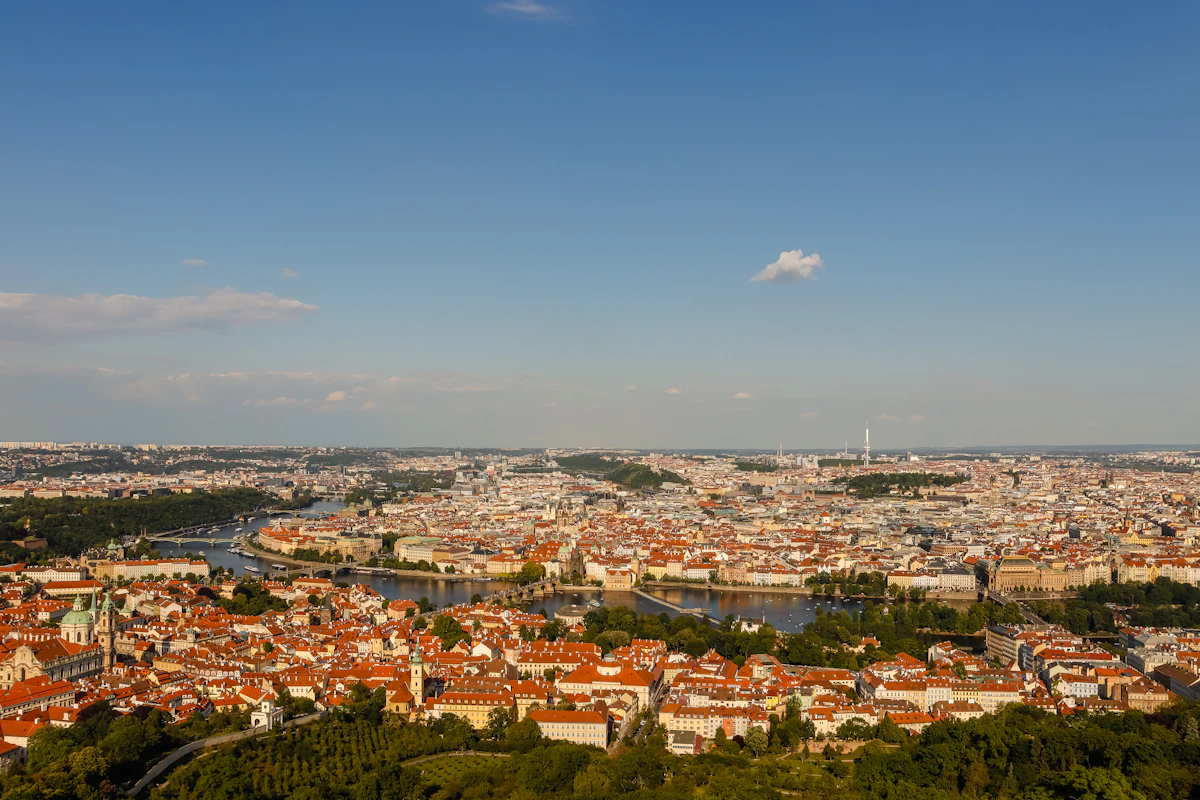
One Day in Prague: The Perfect 2026 Itinerary
Only one day in Prague? This 2026 hour-by-hour walking itinerary covers Old Town, Charles Bridge, the Jewish Quarter, and Prague Castle with meal stops.