Prague Itinerary 2026: 5-Day Plan with Day Trips
The luxury of time — three days in the city, two days in the Bohemian countryside
Powered by ITINE
Get this guide as a tappable itinerary
Day-by-day plan, audio tours, and one-tap Google Maps — completely free.

Destinations
Your Itinerary
Google Maps
Day 1: Old Town & the Jewish Quarter
Morning — Charles Bridge at Dawn & Old Town Square
Five days is a generous gift to give Prague. It means you can see every essential landmark without rushing, push deep into the neighbourhoods most visitors never find, and — critically — leave the city entirely to explore the Bohemian countryside that shaped Czech identity long before Prague became a capital. This itinerary gives you three days in the city (building from the historic core outward) and two carefully chosen day trips that reveal a different side of the Czech story: medieval silver wealth, Gothic spirituality, and the quiet beauty of the landscape between the hills. The day trips are placed on Days 4 and 5, but you can rearrange freely — if rain is forecast for a city day, swap in a day trip instead, as Kutná Hora's interiors are stunning regardless of weather. Check train schedules on <a href="https://www.cd.cz/en/" target="_blank" rel="noopener noreferrer">cd.cz (Czech Railways)</a> or the IDOS app the night before.
Be on Charles Bridge before 7 AM. This instruction appears in every Prague itinerary because it is absolutely correct. The 516-metre Gothic bridge, completed in 1402 and adorned with 30 Baroque statues, is one of Europe's most beautiful structures — but only when it is empty. At dawn, with the Vltava mist softening the Castle silhouette and the lamplighter making his final rounds, you will understand why Kafka called Prague 'a little mother with claws.' She grabs you here and does not let go.
Walk back to Old Town Square for the 9 AM Astronomical Clock performance. Then step inside the Church of Our Lady before Týn (free entry, erratic opening hours — check the posted schedule by the entrance on Celetná side). The Gothic interior is darker and more dramatic than St. Vitus, with a beautiful Gothic Madonna and the tomb of astronomer Tycho Brahe, who died in Prague in 1601 under mysterious circumstances.
Café Letka
Neighbourhood Café & BreakfastLetohradská 44, Praha 7 – Holešovice
Insider tip: A quick tram ride from Old Town to Holešovice. Locals consider this one of Prague's best breakfast spots — the eggs Florentine and homemade granola are outstanding. A calmer alternative to crowded Old Town cafés.
Late Morning — Josefov (Jewish Quarter)
The Jewish Museum combined ticket (350 CZK) covers five sites: the Old Jewish Cemetery, the Pinkas Synagogue, the Spanish Synagogue, the Maisel Synagogue, and the Klausen Synagogue. Allow a full 2.5 hours. The Pinkas Synagogue, its walls inscribed with 77,297 names of Czech and Moravian Holocaust victims, paired with the upstairs exhibition of children's art from Terezín, is among the most powerful memorial spaces in Europe. The Old Jewish Cemetery — 12,000 tombstones packed over twelve layers of burials from the 15th to 18th centuries — is haunting and unforgettable.
Lunch & Afternoon
Lokál Dlouhááá
Czech RestaurantDlouhá 731/33, Praha 1 – Staré Město
Insider tip: The tank Pilsner Urquell here is unpasteurised and delivered fresh from the Pilsen brewery every few days. Order svíčková (beef sirloin in cream sauce) or vepřo-knedlo-zelo (pork with dumplings and sauerkraut) for the definitive Czech lunch.
After lunch, visit the Clementinum (300 CZK guided tour) for its astonishing Baroque Library Hall and Astronomical Tower views. Then wander south through the lanes of Staré Město to the Church of St. James (Kostel sv. Jakuba) on Malá Štupartská — longest nave in Prague, free organ concerts on selected days, and a mummified forearm hanging by the entrance that has its own macabre legend.
Evening — Cocktails & Dinner
Field Restaurant
Modern European Fine DiningU Milosrdných 12, Praha 1 – Staré Město
Insider tip: One Michelin star. Chef Radek Kašpárek's tasting menus showcase Czech ingredients with Nordic precision. Book at least a week ahead. The wine pairing is exceptionally well curated.
If a Michelin tasting menu is not in your budget, head to Kantýna (Politických vězňů 5) for impeccable Czech beef steaks and Moravian wines, or to Lokál (see lunch) for a second round of the best affordable food in the centre. Either way, end the evening at Hemingway Bar (Karoliny Světlé 26) for an expertly made cocktail or Czech absinthe.
Day 2: Castle District & Malá Strana
Morning — Prague Castle from Above
Tram 22 to Pohořelec. Enter the Castle from the western end and walk downhill through the complex. Buy Circuit B (250 CZK). Start at St. Vitus Cathedral before the tour groups arrive — head directly to the nave, find the Mucha Window in the third chapel on the left, then descend to the Royal Crypt. The Old Royal Palace's Vladislav Hall, with its extraordinary late-Gothic vaulted ceiling spanning the width of the room without a single supporting column, will take your breath. Golden Lane is charming for fifteen minutes — Kafka's blue house is No. 22.
Late Morning — Strahov Monastery
A 10-minute walk west from the Castle. The Theological Hall and Philosophical Hall libraries (150 CZK) are among the most beautiful rooms in Prague. The monastery brewery next door serves its own St. Norbert beer — the amber lager is excellent. Have an early lunch here: the pork knee with Strahov dark beer is a classic.
Strahov Monastic Brewery
Brewery & RestaurantStrahovské nádvoří 301/10, Praha 1 – Hradčany
Insider tip: The dark wheat beer (sv. Norbert tmavé) is only available here. The vaulted cellar dining area has excellent atmosphere. Arrive before noon to avoid the post-Castle lunch rush.
Afternoon — Malá Strana & Kampa
Walk down through the Petřín orchards or along Úvoz and Nerudova streets into Malá Strana. Visit the Church of St. Nicholas on Malostranské náměstí — the most important Baroque church in Prague, with a dome fresco by Johann Lukas Kracker that covers 1,500 square metres. Entry 100 CZK. Then find the hidden entrance to Vrtbovská zahrada at Karmelitská 25 — a terraced Baroque garden from 1720 with views that rival anything in the Castle. Most tourists walk right past it.
Cross through to Kampa Island via the steps from Charles Bridge or through the archway from Maltézské náměstí. The Kampa Museum of modern Central European art is worth an hour, and David Černý's crawling baby sculptures in the adjacent park are one of Prague's most iconic contemporary art pieces. Walk south along the riverbank to the point of Kampa where children feed swans and the weir creates a rushing sound that drowns out the city.
Evening — Petřín Hill & Dinner
Take the Petřín funicular (covered by transit pass) up for sunset. The Petřín Lookout Tower (150 CZK, 299 steps) offers a 360-degree panorama that is incomparable at golden hour. On the way down, walk through the Petřín rose garden and the remnants of the Hunger Wall, a fortification built by Charles IV in 1360 as a public works project to feed the poor during a famine — hence the name.
Cotto Crudo
Italian Fine DiningFour Seasons Hotel, Veleslavínova 1098/2a, Praha 1
Insider tip: Request a riverside terrace table at sunset for a view of Charles Bridge and the Castle that is legitimately one of the most beautiful restaurant views in Europe. The handmade pasta is outstanding.
Day 3: Vinohrady, Žižkov & Vyšehrad
Morning — Vinohrady & Riegrovy sady
Today you leave the tourist corridor. For more places that most visitors overlook, see our guide to <a href="/hidden-gems-off-beaten-path">Prague's hidden gems</a>. Take the metro to Náměstí Míru (Line A) and spend the morning in Vinohrady — Prague's most elegant residential neighbourhood. The Art Nouveau apartment buildings along Mánesova, Slavíkova, and Korunní streets are some of the finest in Central Europe. Walk through Riegrovy sady park to the beer garden on the bluff — the panoramic view of Prague's skyline, from the Castle across to the Žižkov Tower, is one of the best in the city and costs nothing more than a 50 CZK beer.
Viniční Altán
Wine Bar & Garden PavilionHavlíčkovy sady, Praha 2 – Vinohrady
Insider tip: A 19th-century pavilion set in the middle of a historic vineyard inside Havlíčkovy sady park. The vineyard has been producing wine since the 14th century. Sit on the terrace overlooking the Grotta grotto fountain. One of the most beautiful secret spots in Prague.
Late Morning — Žižkov & the TV Tower
Walk northeast into Žižkov, Prague's grittiest and most characterful district. The Žižkov Television Tower (250 CZK observation deck) is 216 metres of Brutalist concrete decorated with David Černý's crawling baby sculptures — universally despised when it was built in the 1980s, now grudgingly beloved. The observation deck at 93 metres gives you a completely different perspective on Prague than the Castle views. On a clear day, you can see 100 kilometres in every direction.
After the tower, walk uphill to the National Monument on Vítkov Hill. This massive functionalist building from 1929 houses a museum of Czech 20th-century history, and the terrace in front of Jan Žižka's enormous bronze equestrian statue (the third-largest in the world) commands a dramatic view over all of Prague. The museum is underrated and often empty.
Afternoon — Vyšehrad
Metro to Vyšehrad (Line C). This cliff-top fortress predates Prague Castle, and according to legend is where Princess Libuše prophesied the founding of Prague. Walk the full circuit of the ramparts for sweeping Vltava views. The Vyšehrad Cemetery holds the remains of Dvořák, Smetana, Mucha, and Čapek among ornate 19th-century tombstones. The Basilica of St. Peter and St. Paul has a luminous Art Nouveau interior, and the 11th-century Rotunda of St. Martin is one of Prague's oldest buildings.
The casemates (underground passages in the fortification walls) are open for guided tours and include a hall displaying several original Baroque statues from Charles Bridge, removed for preservation. These are atmospheric and uncrowded. Allow 2 hours for the full Vyšehrad experience.
Evening — Náplavka & Dinner
Walk north from Vyšehrad along the river to the Náplavka embankment — Prague's favourite waterside promenade. On Saturdays, the farmers' market here (8 AM–2 PM) is excellent, but any evening the moored boats (converted into bars and galleries) are lively. Grab a drink from one of the floating bars and sit on the river wall watching the city light up.
Eska
Modern Czech RestaurantPernerova 49, Praha 8 – Karlín
Insider tip: The fermentation lab, the sourdough bakery, the seasonal Czech menu — Eska is the best expression of where Prague's food scene is heading. Book 3–4 days ahead for weekend dinners.
Day 4: Day Trip: Kutná Hora
Why Kutná Hora
Kutná Hora, 80 kilometres east of Prague, was once the second most important city in Bohemia — a silver mining powerhouse that funded kings and cathedrals. Our <a href="/kutna-hora-day-trip">Kutná Hora day trip guide</a> has a detailed hour-by-hour plan if you want to explore beyond the highlights below. Today it is a <a href="https://whc.unesco.org/en/list/732" target="_blank" rel="noopener noreferrer">UNESCO World Heritage Site</a> with a population of 20,000 and three of the most remarkable buildings in the Czech Republic. The direct train from Praha hlavní nádraží (Prague Main Station) takes about 55 minutes and costs 109 CZK each way. Trains depart hourly; aim for the 8:00 or 9:00 AM departure.
Morning — Sedlec Ossuary (The Bone Church)
The Sedlec Ossuary — known worldwide as the Bone Church — is a small chapel beneath the Cemetery Church of All Saints, decorated with the bones of approximately 40,000–70,000 people. In 1870, a local woodcarver named František Rint was hired to organise the bones that had accumulated from centuries of plague burials and Hussite Wars. His solution was to use them as art: a chandelier containing at least one of every bone in the human body, a coat of arms made from skulls and femurs, garlands of bones draped from the vaulted ceiling. The result is simultaneously beautiful, grotesque, and profoundly humbling. Entry is 160 CZK.
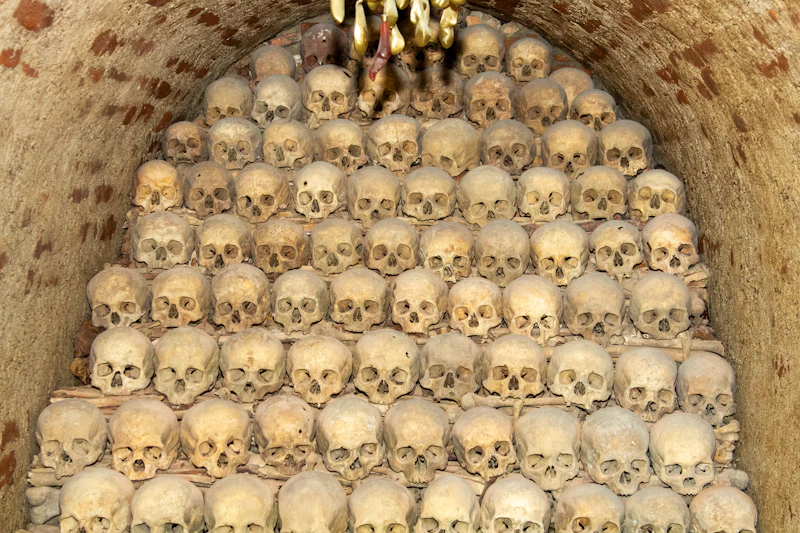
Do not rush this. Fifteen minutes is not enough — take thirty. Stand beneath the chandelier and look at how the light passes through the bone garlands. Read the plaques. Understand that these were real people, most of them killed by plague in the 14th century or slaughtered in the Hussite Wars of the 15th. The ossuary is a meditation on death that would have been perfectly understood by medieval Christians and remains startling to modern visitors.
Midday — Cathedral of St. Barbara
Walk or take the shuttle train into Kutná Hora's old town and head to the Cathedral of St. Barbara (Chrám svaté Barbory), the undisputed masterpiece of the town. This late-Gothic cathedral, begun in 1388 and not completed until 1905, was built by the silver miners as a rival to Prague's St. Vitus. The exterior is a forest of flying buttresses and pinnacles. The interior is luminous and soaring, with frescoes in the side chapels depicting medieval mining life — rare secular subjects in a sacred space. The ribbed vaulting of the nave, designed by Benedikt Ried (the same architect who built the Vladislav Hall in Prague Castle), is mesmerising. Entry 120 CZK.
The approach to the cathedral along the Jesuit Terrace — a tree-lined promenade with Baroque statues overlooking the Vrchlice valley — is one of the most picturesque walks in the Czech Republic. Take your time.
Lunch in Kutná Hora
Restaurace Dačický
Traditional Czech RestaurantRakova 8, Kutná Hora
Insider tip: Named after the 16th-century Kutná Hora chronicler. The svíčková is reliable, and the house lager is brewed locally. The Renaissance painted ceiling in the upstairs dining room is genuine. Solid, honest Czech food.
Afternoon — Italian Court & Town Exploration
The Italian Court (Vlašský dvůr) was the royal mint of Bohemia from 1300, where the Prague groschen — one of medieval Europe's most important currencies — was struck. The guided tour (120 CZK, 45 minutes) takes you through the mint workshops, the royal chapel, and the audience hall where Bohemian kings once received foreign delegations. For a town of 20,000, the scale of these buildings tells you everything about how much silver money once flowed through here.
Spend the remaining afternoon wandering Kutná Hora's quiet streets. The Stone House (Kamenný dům) on Václavské náměstí has one of the most ornate late-Gothic facades in Bohemia. The Church of St. James near the Italian Court has a slightly tilted tower (the miners dug too close to the foundations). The town has a pace and charm that Prague's centre has lost — linger, sit in a café, and catch the 4 or 5 PM train back to Prague.
Day 5: Day Trip: Karlštejn Castle & Farewell Dinner
Morning — Train to Karlštejn
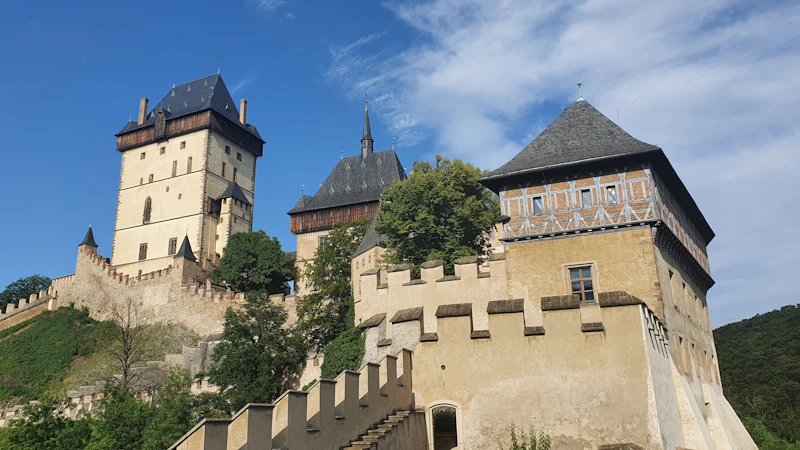
Karlštejn Castle, perched on a limestone cliff 30 kilometres southwest of Prague, is the most visited castle in the Czech Republic — and for good reason. Our <a href="/karlstejn-castle-day-trip">Karlštejn day trip guide</a> covers both tour circuits, the river walk to Srbsko, and booking strategy in full detail. Built between 1348 and 1365 by Emperor Charles IV as a treasury for the Holy Roman Empire's crown jewels and holy relics, it is a Gothic fortress of rare power and beauty. The train from Praha-Smíchov station takes just 33 minutes and costs 59 CZK. Trains depart every 30–60 minutes; catch the 8:30 or 9:00 AM departure.
From Karlštejn village station, it is a pleasant 20-minute uphill walk through the village to the castle gates. The path passes through a wooded valley and the village itself has a few decent cafés for a pre-tour coffee. Avoid the tourist stalls selling Bohemian crystal and garnet — the quality is inconsistent and the prices are inflated.
The Castle
Karlštejn is arranged in a dramatic ascending sequence: the village, the outer walls, the Imperial Palace, the Marian Tower with the Church of Our Lady, and finally the Great Tower crowned by the Chapel of the Holy Cross. This vertical hierarchy was deliberate — Charles IV conceived the castle as a spiritual ascent, with each level bringing the visitor closer to the holiest relics stored at the summit. The Chapel of the Holy Cross, with its gold-leafed ceiling, walls studded with jasper, amethyst, and agate, and 129 panel paintings by Master Theodoric (the most important cycle of Gothic panel painting in Central Europe), is quite simply one of the most extraordinary rooms in existence.
Even on Tour 1, the castle is impressive. The Imperial Palace halls, the defensive architecture, and the views from the Great Tower over the Berounka River valley are magnificent. Charles IV chose this site with care — the limestone cliff provided natural defence, and the surrounding forests ensured solitude for his spiritual retreats.
Lunch in Karlštejn Village
Restaurace Pod Dračí Skálou
Czech RestaurantKarlštejn 154, 267 18 Karlštejn
Insider tip: Set just below the castle with a terrace overlooking the valley. The grilled trout is fresh from local streams. Better food than most castle-adjacent restaurants — the owners take genuine pride in the kitchen.
Optional: Berounka River Walk
If the weather is fine and your legs are willing, do not take the train directly back to Prague. Instead, walk from Karlštejn village along the marked trail that follows the Berounka River northeast to the village of Srbsko (about 6 km, 90 minutes). The path winds through limestone canyons, past the Sv. Jan pod Skalou monastery tucked into a cliff face, and through some of the most beautiful landscape within an hour of Prague. Srbsko has its own train station with regular service back to Praha-Smíchov. This walk, on a warm afternoon with the river glittering beside you, is one of the best-kept secrets near the capital.
Evening — Farewell Dinner in Prague
Your last evening in Prague deserves something special. La Degustation Bohême Bourgeoise, the city's most celebrated restaurant, offers a seven-course tasting menu that reinvents traditional Czech cuisine through the lens of molecular gastronomy and historical recipes unearthed from 19th-century Czech cookbooks. The dining room is intimate, the service impeccable, and the food — dishes like trout with smoked butter and dill, or venison with juniper and elderberry — is a revelation. Two Michelin stars, and every one earned.
La Degustation Bohême Bourgeoise
Fine Dining (Two Michelin Stars)Haštalská 18, Praha 1 – Staré Město
Insider tip: Book at least 2 weeks in advance. This is the best restaurant in the Czech Republic and one of the best in Central Europe. The menu changes completely with the seasons. If you can only do one splurge meal in Prague, this is it.
If La Degustation is beyond your budget or fully booked, two excellent alternatives: Eska (Pernerova 49, Karlín) for modern Czech fermentation cuisine, or Sansho (Petrská 25) for Asian-Czech fusion by a Scottish chef who sources obsessively from Czech farms. Both are outstanding and more accessible at 600–900 CZK per person including drinks.
One Last Walk
After dinner, walk back to Charles Bridge one final time. At night, with the statues lit from below and the Castle glowing on the hill, the bridge takes on yet another character — theatrical, almost operatic. You have now seen it at dawn, during the day, and at night. You have seen the tourist Prague and the local Prague. You have eaten dumplings in a crowded beer hall and tasted Michelin-starred reinventions of the same tradition. You have stood in a chapel made of human bones and a chapel encrusted with gems. That is what five days in Prague gives you — not just a trip, but the beginning of a relationship with a city that has been earning devotion for a thousand years.
- Total walking distance: approximately 55–65 km over 5 days
- Total cost estimate: 7,000–12,000 CZK per person (meals, tickets, day trips, transport, drinks)
- Day trip transport: Kutná Hora ~220 CZK return, Karlštejn ~120 CZK return
- Essential apps: Lítačka (transit), Mapy.cz (navigation), IDOS (train schedules), Bolt (taxis)
- Final tip: download offline maps for Mapy.cz — Czech mobile data works well, but the app is faster offline and drains less battery
Frequently Asked Questions
Not at all. Five days lets you explore the city at a relaxed pace and take two outstanding day trips into the Bohemian countryside. You will see Prague's major sights without rushing, push into local neighbourhoods, and visit Kutná Hora and Karlštejn Castle — both UNESCO-calibre experiences you would miss on a shorter trip.
Budget roughly 7,000–12,000 CZK per person (280–480 EUR) for five days, excluding accommodation. This covers all meals, entrance fees, two day trips by train, transport passes, coffee, and beer. Using lunch specials and neighbourhood pubs keeps costs toward the lower end.
Absolutely. Kutná Hora is a UNESCO World Heritage Site with the Sedlec Ossuary (Bone Church), the stunning Cathedral of St. Barbara, and the Italian Court royal mint. The train takes 55 minutes and costs 109 CZK each way. It is one of the best day trips in Central Europe. See our Kutná Hora day trip guide for the full plan.
Take the train from Praha-Smíchov station to Karlštejn — it takes just 33 minutes and costs 59 CZK. Trains depart every 30–60 minutes. From the village station, it is a pleasant 20-minute uphill walk to the castle gates. Book Tour 2 (Chapel of the Holy Cross) in advance at hradkarlstejn.cz if visiting May–October.
Tour 2 (480 CZK, 70 minutes) includes the extraordinary Chapel of the Holy Cross with 2,000+ semi-precious stones and 129 Gothic panel paintings — it is one of the most remarkable rooms in Europe. Tour 1 (330 CZK) covers the basic interiors and is still impressive. Tour 2 requires advance booking and runs May–October only.
The Sedlec Ossuary is a chapel beneath a cemetery church in Kutná Hora, decorated with the bones of approximately 40,000–70,000 people. A chandelier containing every bone in the human body, garlands of skulls, and a coat of arms made from femurs make it one of the most extraordinary spaces in Europe. Entry is 160 CZK.
La Degustation Bohême Bourgeoise (two Michelin stars) is the best restaurant in the Czech Republic — a seven-course tasting menu reinventing historic Czech recipes for 3,950 CZK. Book at least 2 weeks ahead. For a more accessible option, Eska in Karlín (295–495 CZK mains) offers outstanding modern Czech cuisine.
Buy tickets at any Prague train station, on the Czech Railways (ČD) website, or through the IDOS app. Tickets to Kutná Hora cost 109 CZK each way; Karlštejn costs 59 CZK each way. No advance booking is needed for the train itself — just show up and buy at the station.
Yes. The day trips on Days 4 and 5 can be swapped to any day. A useful strategy is to save a day trip for a rainy day — Kutná Hora's interiors (the Ossuary, Cathedral of St. Barbara, Italian Court) are spectacular regardless of weather, while Prague's outdoor attractions are best saved for clear days.
A beautiful 6 km riverside trail from Karlštejn village to Srbsko, following the Berounka River through limestone canyons. It takes about 90 minutes and passes the cliff-face monastery at Sv. Jan pod Skalou. Srbsko has its own train station back to Prague. This walk is one of the best-kept secrets near the capital.
Yes. Field holds a Michelin star and serves hyper-seasonal Czech ingredients with Scandinavian precision. The tasting menu starts at 1,990 CZK — roughly half what comparable Michelin restaurants charge in Paris or London. Book at least a week ahead. The wine pairing is excellent.
Vinohrady for elegant Art Nouveau architecture and café culture, Žižkov for authentic pub culture and the TV Tower, and Karlín for Prague's most exciting food scene. All three are easily reached by metro or tram and feel completely different from the tourist centre.
Four essential apps: Mapy.cz (navigation, superior to Google Maps), Lítačka (public transport tickets and real-time tracking), IDOS (train and bus schedules for day trips), and Bolt (taxis). Download offline maps for Mapy.cz to save battery.
Yes, if your Day 3 falls on a Saturday. The Náplavka farmers' market runs Saturday mornings year-round along the Vltava embankment (the winter edition is smaller but still worthwhile). Local producers sell seasonal vegetables, artisan cheeses, smoked meats, and fresh bread. Arrive before 10:00 for the best selection. It is almost entirely a local crowd.
The Žižkov Television Tower observation deck is at 93 metres and costs 250 CZK. On clear days you can see 100 km in every direction. David Černý's crawling baby sculptures on the exterior are an iconic Prague sight. The tower also has a one-room hotel suite if you want to sleep at 70 metres.
Prague has several outstanding viewpoints. Letná Park offers the classic five-bridge river panorama. The Petřín Tower gives a 360-degree aerial view. Vyšehrad's western ramparts are best at sunset. The Old Town Bridge Tower looks down Charles Bridge toward the Castle. Each offers something different — try to hit at least two during five days.
James Whitfield
Travel Writer & Prague Resident · Vinohrady, Prague
James moved to Prague in 2017 after a decade of travel writing across Central Europe. A former editor at Wanderlust Magazine, he now writes practical travel guides drawn from eight years of navigating the city's tram network, budget pubs, and bureaucratic quirks.