
Prague vs Krakow: Which Eastern European City Wins? (2026)
Two of Europe's most beloved medieval cities compared — from pierogi to pilsner, Auschwitz to the Astronomical Clock
Powered by ITINE
Get this guide as a tappable itinerary
Day-by-day plan, audio tours, and one-tap Google Maps — completely free.

Destinations

Your Itinerary
Google Maps
Prague and Krakow are the two cities that dominate every 'best of Eastern Europe' list, and for good reason. Both are stunningly beautiful medieval cities that survived World War II largely intact. Both are affordable by Western European standards. Both have incredible nightlife, rich history, and a magnetic atmosphere that draws millions of visitors annually. And yet they feel remarkably different. Prague is the polished gem — carefully maintained, globally famous, and increasingly sophisticated. Krakow is the scrappy underdog — rawer, cheaper, more intense, and arguably more authentically 'Eastern European' in character. This guide will help you choose the right one for your trip.
Which city is cheaper — Prague or Krakow?
Krakow is cheaper. Significantly so. Poland's zloty (PLN) gives your euros and dollars serious purchasing power, and Krakow — despite its tourism boom — remains one of the best-value cities in Europe. Prague is still affordable by Western standards, but its prices have been climbing steadily and it now sits in a middle ground between Eastern and Western European costs. If pure budget is your priority, Krakow wins before we even look at the details.
How do accommodation prices compare?
A mid-range hotel in central Krakow (Old Town or Kazimierz) costs 250-500 PLN (58-116 EUR) per night for a double room. In Prague, equivalent quality in Vinohrady or Staré Město runs 2,500-4,000 CZK (100-160 EUR). Hostels tell the same story: Krakow dorms average 60-120 PLN (14-28 EUR) versus Prague's 500-800 CZK (20-32 EUR). At every level, Krakow is 25-40% cheaper for a place to sleep.
What about food and drink costs?
- Lunch menu: Prague polední menu 150-200 CZK (6-8 EUR) vs Krakow lunch set 25-40 PLN (5.80-9.30 EUR) — roughly comparable
- Dinner main course: Prague 250-400 CZK (10-16 EUR) vs Krakow 35-65 PLN (8-15 EUR) — Krakow slightly cheaper
- Beer (0.5L draft): Prague 50-70 CZK (2-2.80 EUR) vs Krakow 12-18 PLN (2.80-4.20 EUR) — Prague wins on beer
- Vodka shot: Krakow 8-15 PLN (1.85-3.50 EUR) — this is where Krakow gets dangerous for your wallet and your liver
- Coffee: Prague 65-90 CZK (2.60-3.60 EUR) vs Krakow 12-20 PLN (2.80-4.65 EUR) — similar prices
- Street food (zapiekanka/obwarzanek vs trdelník): Krakow wins — a zapiekanka (Polish baguette pizza) from Plac Nowy costs 15-25 PLN (3.50-5.80 EUR), and an obwarzanek (pretzel ring) is 3-5 PLN (0.70-1.16 EUR)
- Dinner for two with drinks: Prague 1,200-1,800 CZK (48-72 EUR) vs Krakow 150-300 PLN (35-70 EUR) — Krakow is cheaper but the gap narrows at nicer restaurants
Which city has better nightlife — Prague or Krakow?
This is genuinely close, and the answer depends on what kind of night out you want. Krakow's nightlife is concentrated in the cellars and basements beneath the Old Town and Kazimierz. The city literally has underground nightlife — vaulted brick cellar bars that are atmospheric, intimate, and often wild. The Kazimierz district (the old Jewish Quarter, now the city's bohemian nightlife hub) packs an extraordinary density of bars, clubs, and late-night spots into a small area. Vodka is dangerously cheap. The energy is young, international, and intense.
Prague's nightlife is more varied. The bar scene ranges from centuries-old beer halls to slick cocktail bars to underground techno clubs in Holešovice. Žižkov has the most pubs per capita of any neighborhood in Europe (or so the legend goes). The beer quality is incomparably better than anything in Krakow — Czech lager is the best in the world, and drinking it fresh from the tank in a proper Prague pub is a near-religious experience. But Krakow's nightlife has a rawer, more spontaneous energy that Prague's increasingly polished scene sometimes lacks.
- Beer quality: Prague wins by a country mile — Czech beer culture is the best on the planet
- Vodka and spirits: Krakow wins — Polish vodka is excellent and absurdly cheap
- Club scene: Roughly tied — both have strong electronic music scenes
- Bar atmosphere: Krakow's cellar bars are unique; Prague's traditional pubs are unmatched. Call it a draw.
- Stag/hen parties: Both cities have them (both cities wish they didn't)
- Cost of a night out: Krakow is slightly cheaper overall, but Prague's cheap beer narrows the gap
- Late-night food: Krakow wins — zapiekanki at Plac Nowy at 3 AM is a Polish institution
How do the food scenes compare — Czech vs Polish cuisine?
I am going to be honest: Polish food is more interesting and more varied than Czech food. Both cuisines are meat-and-potato-heavy Central European comfort food, but Polish cooking has more range. Pierogi alone come in a dozen varieties — ruskie (potato and cheese), z mięsem (meat), z kapustą i grzybami (cabbage and mushroom), z jagodami (blueberry). Then there is żurek (fermented rye soup, utterly unique and delicious), bigos (hunter's stew), gołąbki (stuffed cabbage rolls), and placki ziemniaczane (potato pancakes). The street food is better too — obwarzanki, zapiekanki, and kielbasa from market vendors.
Czech cuisine has its highlights — svíčková is genuinely excellent when done well, and Czech dumplings are pillowy comfort — but it can feel repetitive after a few days. Where Prague fights back is in its modern dining scene, which is more developed than Krakow's. Prague has more creative contemporary restaurants, better international food (excellent Vietnamese food in particular, thanks to the Czech-Vietnamese community), and a more sophisticated fine dining scene. For traditional food, Krakow wins. For modern, cosmopolitan dining, Prague has the edge. Read our Prague food guide for top recommendations.
Which city has more historical significance — Prague or Krakow?
Both cities are deeply historically significant, but in different ways. Prague was the seat of the Holy Roman Empire under Charles IV, the birthplace of the Defenestration that triggered the Thirty Years' War, the site of the Prague Spring in 1968, and the stage for the Velvet Revolution in 1989. Its history is woven into its architecture — every building tells a story spanning a millennium. The Prague Castle complex has been continuously occupied since the 9th century.
Krakow was Poland's royal capital for 500 years, and the Wawel Castle and Cathedral are central to Polish national identity. But what gives Krakow its deepest historical gravity is its proximity to the Holocaust. Auschwitz-Birkenau is 70 km away — a 1.5-hour bus ride. The former Jewish ghetto and Oskar Schindler's factory are in the city itself. Kazimierz was one of the great centers of Jewish life in Europe before the war. This is not easy tourism, but it is profoundly important tourism, and Krakow handles it with appropriate gravity.
How do Jewish heritage sites compare?
Both cities have deeply significant Jewish heritage, and both handle it with respect. Prague's Josefov (Jewish Quarter) has survived remarkably well — the Old Jewish Cemetery, the Spanish Synagogue, the Old-New Synagogue (the oldest active synagogue in Europe, dating to 1270), and the Jewish Museum form a powerful ensemble. The survival of these sites through WWII is itself a complex story — the Nazis preserved them for a planned 'museum of an extinct race.'
Krakow's Jewish heritage is more directly connected to the Holocaust. Kazimierz was a thriving Jewish neighborhood before the war, and today it functions as both a living neighborhood and a memorial. The Old Synagogue, Remuh Synagogue, and the Jewish Cultural Center tell the story of pre-war Jewish life. Across the river, the former ghetto in Podgórze and the Schindler's Factory museum tell the story of destruction. And Auschwitz-Birkenau, accessible as a day trip, is the most significant Holocaust memorial site in the world. If Jewish history is central to your travel, Krakow offers the more comprehensive and more emotionally intense experience.
What are the best day trips — Kutná Hora vs Auschwitz and beyond?
Prague day trips
- Kutná Hora: The Bone Church (Sedlec Ossuary) and a beautiful medieval silver town. 1 hour by train.
- Český Krumlov: A fairy-tale UNESCO town that rivals Prague itself. 2.5 hours by bus.
- Karlštejn Castle: A Gothic hilltop fortress built by Charles IV. 40 minutes by train.
- Terezín: A former WWII concentration camp. Sobering and essential. 1 hour by bus.
- Pilsen: Birthplace of pilsner beer. Brewery tour at Pilsner Urquell. 1 hour by train.
Krakow day trips
- Auschwitz-Birkenau: The most important Holocaust memorial in the world. 1.5 hours by bus. Book tickets well in advance.
- Wieliczka Salt Mine: An underground cathedral carved from salt — unique in Europe. 30 minutes by bus.
- Zakopane: A mountain resort town in the Tatra Mountains with hiking, skiing, and distinctive wooden architecture. 2 hours by bus.
- Ojców National Park: Limestone valleys, caves, and a castle ruin just 30 minutes from the city.
- Wrocław: Poland's fourth-largest city with a beautiful market square and hundreds of dwarf statues. 3.5 hours by train.
Both cities have excellent day trip options, but they differ in character. Prague's are more fairy-tale; Krakow's are more dramatic. Auschwitz is in a category of its own — it is not a 'fun' day trip, but it is one of the most important things you can do in Europe. The Wieliczka Salt Mine is a genuinely jaw-dropping experience. I would give Krakow a slight edge on day trips for the sheer variety and emotional range.
Which city is safer for tourists?
Both are very safe cities. Prague and Krakow both have low rates of violent crime against tourists, and both are perfectly safe to walk around at night. The usual urban precautions apply: watch for pickpockets in crowded tourist areas, do not leave valuables unattended, and be aware of your surroundings. Prague's main scam zones are Charles Bridge and Old Town Square. Krakow's are the Main Market Square and around Cloth Hall. Neither city has areas that tourists should actively avoid.
Which city is more walkable?
Both cities are extremely walkable, and this is one of their shared strengths. Prague's historic center — Staré Město, Malá Strana, the Castle district — is compact enough to cover on foot. The only significant hill climb is up to the Castle. Krakow's Old Town and Kazimierz are completely flat and very compact — you can walk from the Barbican at the north end of the Old Town to the southern edge of Kazimierz in 25 minutes. Krakow is arguably even more walkable than Prague because it is flatter and slightly more compact. Both cities have good public transport for reaching outer areas, but most tourist activities are accessible on foot.
How does the beer culture compare?
Prague wins beer culture so decisively that the comparison is almost unfair. The Czech Republic invented pilsner (in Plzeň, 1842), has the highest per-capita beer consumption in the world, and produces lagers that are genuinely the best on the planet. Czech beer is not just cheap — it is a craft perfected over centuries. The tank beer (tankové pivo) system, where unpasteurized lager is delivered fresh to pubs in pressurized tanks, produces beer that is simply unavailable anywhere else. Read our Czech craft beer guide for the full story.
Polish beer is fine. Żywiec, Tyskie, and Okocim are decent mass-market lagers, and the Polish craft beer scene is growing. Krakow has some good craft beer bars. But compared to Czech beer culture, Poland's is a tier below. If beer is important to your trip — and honestly, if you are choosing between these two cities, it probably should be — Prague is the clear winner.
Which city has more tourist crowds?
Prague is significantly more crowded. The city receives roughly 8 million international visitors per year compared to Krakow's 4-5 million, and Prague's tourist attractions are more concentrated into a smaller area. Charles Bridge and Old Town Square can be uncomfortably packed from mid-morning to sunset in summer. Krakow's Main Market Square gets busy, but the city handles its tourist volume better — the crowds feel less oppressive because there are more side streets to escape into and fewer bottleneck points.
If you want to avoid the worst crowds in Prague, follow our hidden gems guide and explore neighborhoods like Vinohrady and Žižkov. In Krakow, simply walking a few blocks from the Main Market Square into the quieter streets of Kazimierz or Podgórze reveals a much less touristy city.
Architecture and atmosphere: Gothic Prague vs Renaissance Krakow?
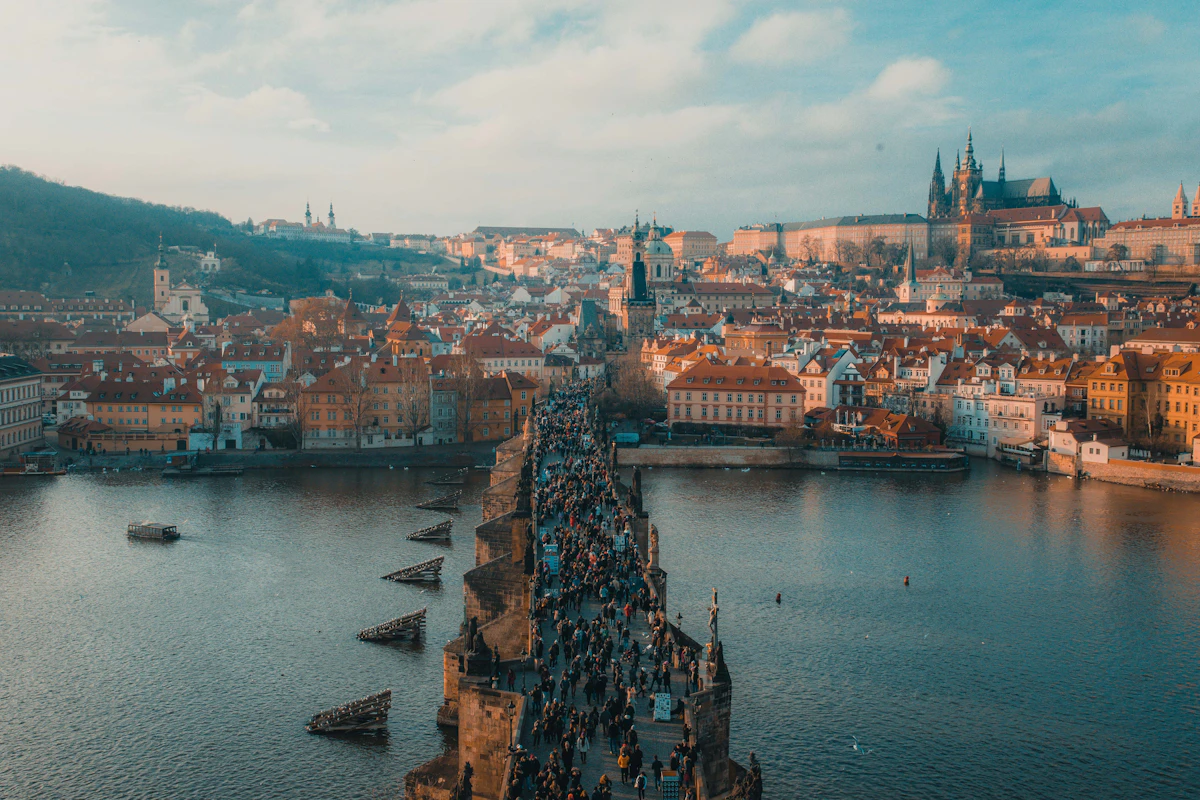
Prague's architectural identity is Gothic — spires, pointed arches, flying buttresses, and a skyline that looks like an illustration from a medieval manuscript. The Charles Bridge, St. Vitus Cathedral, the Powder Tower, and the Old Town Bridge Tower establish the visual language. Layer in baroque churches, art nouveau facades, and cubist oddities, and Prague becomes an architectural encyclopedia spanning 700 years.
Krakow has a different palette. The Cloth Hall in the Main Market Square is Renaissance. Wawel Castle blends Gothic, Renaissance, and baroque. St. Mary's Basilica is Gothic with an extraordinarily ornate interior. The overall impression is of a city that is beautiful but slightly less visually distinctive than Prague. Prague's skyline is one of the most recognizable in the world; Krakow's is lovely but could be mistaken for several other Central European cities. For pure architectural spectacle, Prague wins.
Final verdict: Prague or Krakow in 2026?
Choose Prague if: you prioritize architectural beauty, world-class beer, a fairy-tale atmosphere, and a more 'polished' city experience. Prague is the more beautiful city, the better beer city, and the more instantly impressive destination. It is more expensive than Krakow but still affordable by European standards. Prague rewards slow exploration, romantic walks, and an appreciation for centuries of craftsmanship.
Choose Krakow if: you prioritize budget-friendliness, raw nightlife energy, Polish cuisine, historical gravity (especially Holocaust history), and a city that feels less tourist-polished and more authentically Central European. Krakow is cheaper, grittier, and more intense. The day trip to Auschwitz alone is a reason to visit. The food is more interesting. The nightlife is wilder. And the city has an underdog charm that Prague, in its beauty and fame, sometimes lacks. If Krakow wins you over, check out our detailed Krakow travel guide for help planning your trip.
My honest recommendation for a first-time visitor to either city: Prague. It is more visually stunning, more walkable, and offers a more immediately rewarding experience for someone with 3-4 days. But Krakow is the better second trip — or the better choice for someone who has already seen Prague and wants something different. And if you have the time and inclination, combining both into a 7-10 day Central European trip is one of the best itineraries you can design.
Frequently Asked Questions
Yes. Krakow is approximately 20-35% cheaper than Prague across most categories. Accommodation is the biggest difference. Food and drinks are slightly cheaper in Krakow, though Prague's beer prices are lower. A comfortable daily budget in Krakow is 80-160 EUR vs 110-180 EUR in Prague.
Approximately 535 km. Budget flights take 1-1.5 hours. Buses (FlixBus) take 7-8 hours. Trains take 7-8 hours with a change. Flying is the most practical option unless you enjoy long bus rides.
Both are excellent. Krakow has wilder, cheaper nightlife centered around cellar bars in Kazimierz with very cheap vodka. Prague has superior beer culture, more varied bar types (from ancient pubs to modern cocktail bars), and a strong club scene. For partying: Krakow. For pub culture: Prague.
Polish cuisine is generally more varied and flavorful than Czech cuisine. Krakow's pierogi, żurek, and street food (zapiekanki, obwarzanki) offer more variety. Prague has a better modern dining scene with more creative restaurants. For traditional food: Krakow. For contemporary cuisine: Prague.
Yes, if you are emotionally prepared for it. Auschwitz-Birkenau is 70 km from Krakow (1.5 hours by bus). It is one of the most important memorial sites in the world. Book tickets well in advance on the official museum website. Allow a full day. It is not an easy experience, but it is a profoundly important one.
Prague is generally considered more visually stunning, with its Gothic skyline, fairy-tale lanes, and the Vltava River setting. Krakow is beautiful too — the Main Market Square is one of Europe's largest and finest — but Prague's architectural diversity and dramatic river-and-castle setting give it the edge.
Prague, without question. The Czech Republic has the world's best beer culture, and a half-litre of excellent Czech lager costs just 50-70 CZK (2-2.80 EUR). Polish beer is decent but unremarkable by comparison. If beer is important to your trip, Prague is the obvious choice.
Both are very safe for tourists. Violent crime against visitors is extremely rare in both cities. The main risks are pickpocketing in tourist areas and overcharging in certain restaurants. Use common sense and you will have no problems in either city.
Krakow is slightly better for solo travelers due to its cheaper hostels, more social nightlife scene (especially in Kazimierz), and its compact, easy-to-navigate center. Prague is excellent for solo travelers too, but its pub culture is slightly less social than Krakow's bar scene.
Yes, both cities have widespread English proficiency, especially among younger people and in tourist areas. Prague has slightly more English-language signage and menus. In Krakow, you may encounter less English in neighborhoods outside the Old Town, but tourist areas are fully accessible in English.
Prague has more attractions within the city itself — the Castle complex, Charles Bridge, multiple distinct neighborhoods, and more museums. Krakow's in-city attractions are slightly fewer but supplemented by extraordinary day trips (Auschwitz, Wieliczka Salt Mine, Zakopane). For a 3-day trip, both offer plenty.
Both are cold in winter (around 0°C). Prague has excellent Christmas markets (late November through December) that are among Europe's best. Krakow also has good Christmas markets and is closer to ski resorts in the Tatra Mountains. Prague edges ahead for a Christmas visit; Krakow wins if you want to combine city and mountains.
Neither city uses the euro. Prague uses Czech crowns (CZK) and Krakow uses Polish zloty (PLN). Some tourist businesses accept euros but at poor rates. Use ATMs or a travel card like Revolut for the best exchange rates in both cities.
Both are extremely walkable. Krakow is slightly more walkable because it is flatter and more compact — the Old Town and Kazimierz are easy to cover on foot. Prague is also very walkable but has the hill climb to the Castle district and more cobblestone surfaces that can tire your feet.
Both have excellent day trips. Krakow's standouts are Auschwitz-Birkenau and the Wieliczka Salt Mine — both unique and unforgettable. Prague offers Český Krumlov (a fairy-tale town), Kutná Hora (Bone Church), and Karlštejn Castle. Both are outstanding; Krakow's day trips are more emotionally intense.
Both cities attract stag and hen parties due to cheap drinks and vibrant nightlife. Krakow is typically cheaper for groups. That said, both cities are trying to manage the negative impact of party tourism, and residents of both appreciate visitors who respect local culture and avoid excessive rowdiness.
Prague is more romantic — its fairy-tale architecture, river views, candlelit restaurants, and intimate lanes create a deeply romantic atmosphere. Krakow is lovely for couples too, especially a candlelit dinner in Kazimierz, but Prague has the edge for romance.
James Whitfield
Travel Writer & Prague Resident · Vinohrady, Prague
James moved to Prague in 2017 after a decade of travel writing across Central Europe. A former editor at Wanderlust Magazine, he now writes practical travel guides drawn from eight years of navigating the city's tram network, budget pubs, and bureaucratic quirks.
You might also enjoy
Prague on a Budget: Save Money Without Missing Out
Explore Prague on a budget with 50 CZK beers, free attractions, and lunch menus under 150 CZK. Get our complete money-saving tips for 2026.

Prague Nightlife Guide 2026: Best Bars, Clubs, and Late-Night Spots
Find the best Prague nightlife in 2026 beyond the tourist pub crawls. Our guide covers cocktail bars, jazz clubs, techno venues, rooftop bars, and late-night eats.
Prague's Hidden Gems: Off the Beaten Path in 2026
Skip the tourist crowds in 2026. Explore 15 Prague hidden gems from Vyšehrad fortress to Žižkov's backstreets, with local-only viewpoints, parks, and secret spots.